Wednesday, August 12, 2015

My Experience Attending National Order of the Arrow Conference

Last week I attended the National Order of the Arrow Conference (NOAC) at Michigan State University with my two youngest sons. The Order of the Arrow is a service subdivision of the Boy Scouts, known as Scouting's national honor society. The organization's largest event, NOAC is held about every three or four years.
This NOAC was special, because it represented the centennial celebration of the founding of the OA. What started as a little program to honor campers at one Scout summer camp has expanded into an organization with about 165,000 members. 15,000 of those members were at MSU last week. The only reason there weren't a few thousand more in attendance was that there was simply no way that the venue could host more people and there was little chance of getting another venue that could.
I'm not big on attending conventions. I have arrived at a stage in life where large crowds aren't that appealing and where many large events are simply less personal extrapolations of smaller events. While larger events can take advantage of economies of scale, they almost always entail logistical drawbacks in exchange. Many people in my profession love going to information technology conferences. Me, not so much.

Planning to attend NOAC
Despite my dislike of large events, our family made a commitment and we started plunking down money more than a year ago for the boys and me to attend this function. The boys (especially Son #3) had a strong desire to attend.

Son #3 had attended NOAC in 2012, which was also held at MSU. Until last week, that NOAC had been the largest OA event ever, with 8,000 attendees. Son #4 was new to the OA last year, but he had the idea that he would like to attend the event. We figured that it was likely a once in a lifetime opportunity for me to share an experience like this with the two boys.

I had an idea of what NOAC was all about, having attended the 1979 NOAC at Colorado State University (4,351 attendees) and the 1986 NOAC at Central Michigan University (3,700 attendees). Of course, that was a long time ago and the crowd sizes were orders of magnitude smaller.

By late autumn last year it became clear that there was far more interest in this NOAC than in past events. National asked lodges to limit the number of adult attendees so that more youth could attend. I squeaked by because I had two sons going, one of whom has special needs.

Getting to NOAC
After an entire year of coordination (mostly online, but bolstered with a number of in-person meetings), our lodge contingent of 49 people met at the airport early on a Saturday morning. After the obligatory waiting around, we flew to Detroit, where a chartered bus took us to a hotel. After getting settled in, the bus shuttled us to an Italian restaurant for dinner. Then it was back to the hotel for activities, swimming, relaxing, etc.

On Sunday we attended church. The LDS members of the contingent visited the Dearborn Ward, which was a long way from our hotel. I loved the diversity and feeling of the Spirit in that ward. The remainder of the contingent attended a nondenominational service led by a lay pastor from our group. During our travels, the freeway we were on passed through the infamous Detroit slums. Even from the walled freeway, the blight of what looked like an endless demilitarized zone was unavoidably apparent.
Very early Monday morning we were back on the bus, which took us to the east end of the MSU campus. The check in procedure seemed fairly well designed. We attended a couple of orientation events, had professional group photographs taken, and checked into our dorms. We ended up on the sixth floor of a large and seasoned dormitory that turned out to be a mile from most of the closest events. The large cafeteria served food that was ... well ... cafeteria food. Not terrible, but nothing to write home about. Oh well, somebody had to stay there.

One of the ways that OA members distinguish themselves is by wearing a white sash bearing an embroidered red arrow pointing over the right shoulder. (Bar and triangle devices denote membership/honor types.)
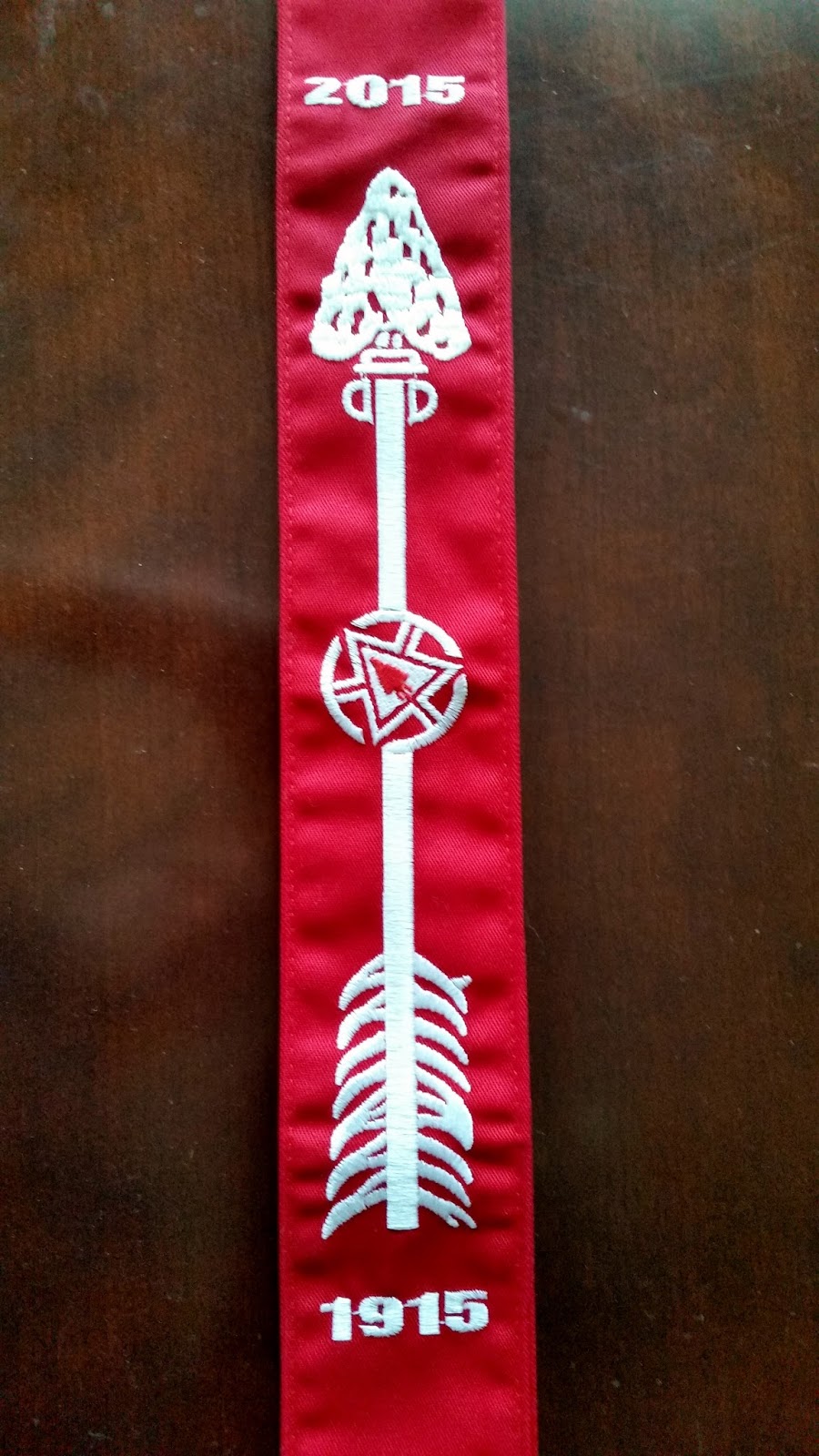
Each NOAC 2015 attendee was given a special centennial sash that has a white arrow with specialized devices (including NOAC 2015 token in the middle of the shaft) embroidered on a red background. Given the limited run, the sash has already become collector item. Although we were all asked to wear our red sashes throughout the week, some attendees refrained from taking theirs out of their wrappers. More on collecting later.
We spent Monday afternoon exploring campus and relaxing. We had arrived on campus before 8 am. Some groups were scheduled to arrive as late as 4 pm. So we counted our blessings.

NOAC shows
The conference began with an opening show at the jam-packed basketball arena on Monday night. In fact, the arena hosted big shows four nights of the conference. Unlike past conferences, everyone had assigned seats. This made getting into the arena much more pleasant.
Before each show they had a pre-show that was very much like pre-game events. They played loud music. Some of it was accompanied with lyrics displayed on the jumbo-tron to encourage singing along. I was surprised at how many of the boys lustily sang along to Neil Diamond's 1969 hit Sweet Caroline. The song was released before many of these boys' parents were born.

Boys also enthusiastically sang along with the 1975 Kiss song Rock and Roll All Nite, which likewise was released before some of these boys' parents entered this world. Although I grew up with these songs, I think that I had never really known what the lyrics said until I saw them scrolling down the big screen in the arena.

The song that took the house down was Let It Go from Disney's Frozen. It was hilarious to see thousands of boys loudly singing this song that they wouldn't be caught dead singing at home in front of their little sisters.

During each pre-show event they brought out this huge T-shirt flinging Gatling gun a couple of times. Each time they would shoot about 20 shirts into the audience. They also had single-shot T-shirt bazookas that fired T-shirts into the upper seats. Son #4 was one of the first ones to catch a T-shirt on Monday night. Then he complained at every subsequent show that they weren't shooting shirts into the area where we were sitting. By my count, he was one of fewer than 2% of attendees that got a shirt that way, so I told him to quit griping and be grateful.

Most of the shows were very Scout and OA based. One night centered around the Distinguished Service Award. Another night focused on how the OA has positively impacted lives. Tuesday was the most entertaining night. The show opened with Charles Peachock, who has an amazing juggling act. Unfortunately, the night concluded a country music act that featured two sopranos that were great at singing third intervals. But they were loud, very high pitched, and every song sounded like a slight variation of the same thing. I can best describe it as grating.

The final show on Friday night was my favorite. It featured a play about honoring the main principles and goals of Scouting even as the program morphs to fit the needs of a modern society. The story was about a Scout camp that was being modernized. Some characters felt that the plan destroyed too much valuable tradition. One character that was a wise old scoutmaster cautioned against making the trivial sacred while trivializing that which should be kept sacred. The main actor was our former lodge chief, who did an amazing job. In fact, all of the actors, both youth and adults, performed at professional levels.

After the Friday night show they had a fancy light, indoor firework, laser, video, music, and confetti display that lasted about 15 minutes. It was a lot of fun. But it was also very loud. I had thankfully brought some earplugs with me.

There were some things that I didn't like about the shows. The main thing was the talking. They sure had lots and lots of public speeches that went on and on. All of the presenters were pretty decent public speakers. But frankly, if you go more than three minutes in a large crowd of Boy Scouts, anything you say after that sounds like the teacher from Charlie Brown. It doesn't matter how good your message is, they won't hear it. And they certainly won't remember it.

The first night the OA national vice chief spoke ... and spoke and spoke. I'm sure he's a great young man. And he is an accomplished public speaker. But, golly, he sure loves to hear himself talk. Mark my words, he'll be a professional politician someday. The national chief talked another night, but to me it seemed easier to listen to than the vice chief's talk. It was still too much. We also heard talks from BSA President Robert Gates (who has been a member of the OA since his youth) and BSA Chief Scout Executive Wayne Brock. A couple of other large events also featured more than sufficient lecture.

Many said that there was far less talking and more informing through entertaining theatrical events at the 2012 NOAC. I tried to imagine the planning for the 2015 event. In my mind's eye I could see someone at a meeting saying, "I attended NOAC in 2012 and we had way, way too much fun stuff at the shows. What we didn't have enough of was talking and lecture. Because everyone knows that Boy Scouts love to hear people talk ad nauseum."

On Friday morning we had an event in the football stadium. While most logistical aspects of NOAC were exceptionally planned and executed, they dropped the ball on getting people into the stadium. We spent half an hour crowded in the stifling space under the stadium. Claustrophobics would have freaked out. The scent was awful. So much BO.

When we finally got to our seats, they announced that we were going to listen to a talk. The audience forgot all about a Scout being courteous they loudly emitted a mass groan. Fortunately, the key speaker was Creek Stewart, Eagle Scout and host of the popular Weather Channel show Fat Guys in the Woods. He was brief and inspiring.

#DareToDo
I still am rather displeased about the national chief's #DareToDo initiative. The good part is that he asked every member of the OA to make a difference in the lives of others by committing to perform one act of unselfish service each day for the next 100 days. I wholeheartedly support this. But then he asked everyone to post each day about their service on social media using the #daretodo hashtag. I disagree with this part of the initiative and I won't do it.

Posting on social media about the service you perform seems to run afoul of the Savior's admonition in Matthew 6:1-4. Those that do good works to impress others "have their reward" — a worldly reward. Jesus asked us to serve quietly, "and thy Father which seeth in secret shall reward thee openly." Maybe it would be good to post daily for 100 days about good acts you observe others carry out.

NOAC events and activities
Like any convention, NOAC offered a variety of classes, seminars, and activities. Participants had to sign up online for classes and certain activities weeks ahead of the conference. But there was also a plethora of formal and informal activities available — so many that there was no way an individual could participate in even half of them.

A friend of mine worked with others from around the nation to put up a very good museum called the GEO (Goodman Edson Observatory). I was very impressed by the museum. The effort that went into putting it together for less than a week astounds me. Everyone I know that visited the GEO, both youth and adults, found it impressive and informative.

A large city park, which was labeled The Hub for this event hosted hoards of outdoor activities and entertainment events. Some of these were under tents. Many were not. But the weather cooperated quite nicely throughout the week.
One of the premier activities was the OA Warrior Challenge, which was a long and broad ranging obstacle course that covered most of a city park.
Son #3 was interested in doing the challenge, but wasn't interested enough to wait in a line that was at least 45 minutes long. Despite his challenges, Son #4 did the challenge early one day when the line was short. Before long he was walking rather than running between stations. When he finally came across the finish line, he felt nauseous. Still, I was proud of him for finishing.

A fellow from our lodge that is an art teacher ran a T-shirt silk screening activity all week long at The Hub. Anyone could bring a blank T-shirt (or hoodie, or neckerchief, or anything else) and get the conference slogan "It starts with us" screened onto it. Our contingent spent a number of hours volunteering at this activity. We screened as many as 16 T-shirts at a time and had a pretty good process going.

There were indoor events around campus too. I spent a lot of time volunteering at the STEM (science, technology, engineering, math) lab. Given my career, I was supposed to work at the software development exhibit. But the exhibit failed to show up. So I was assigned to work at the interactive liquid nitrogen exhibit. The real stuff at the exhibit was handled by chemistry PhD candidates from the school. One of the other volunteers was a career PhD chemist. Although I was the odd man out, once I put on a lab coat and safety glasses, people treated me like a chemist. Amazing how that works. We had lots of fun and it was great to watch the boys (and even the adults) enjoy the activity.

Collecting
One of the major informal activities that occurred all over campus was patch trading. Most that are familiar with Scouting know that patch trading and collecting has a deep hold in the Scouting culture. Outsiders probably have difficulty understanding this mania. Heck, I have trouble understanding it, since I'm not much of a collector. But thousands of youth and adults at NOAC engaged in patch trading. There were trader blankets set up on patches of grass all over the place and most nights the large field house filled with traders.
This is somebody else's collection
My two sons became deeply involved in the patch trading enthusiasm. Almost every night I had to drag them away and force them to return to the dormitory, getting us to bed way too late. Son #4 saw a patch he fancied, but he could find no one that would trade it away. Finally, he hunted down the dorm of the lodge the issued the patch. He camped out in the lobby, pestering passers by until he found a lodge member that would trade for the patch.

And people don't just trade patches. They trade money. Some rare patches sell for hundreds of dollars — which to me seems like an astronomical price, given that they are coughing up big dough for pieces of embroidered cloth. Ebay hosts a vibrant Scout patch trading market. There are even people that make their living at this.

Getting around campus
We had the misfortune of being housed in a dorm that was nearly two miles from most major activity centers. Conference organizers had arranged for buses to run in a continuous loop around campus. But even with all of the buses, it was sometimes quicker to walk than to wait. Plus there was plenty of walking to and from bus stops and at activities. Even with lots of bus riding, my phone tells me that I walked 7-10 miles every day that I was on campus. This is part of the logistical tradeoff of having a large number of conference attendees.

One day I took my boys to the MSU Dairy Store, which was reputed to have very high quality ice cream. We waited in line 40 minutes to see if it lived up to its reputation. The selection seemed meager for someone that is used to choosing flavors at Farr's Ice Cream. The ice cream was good, but it certainly wasn't superior to stuff that can be readily obtained locally. The only thing that made it worth waiting in line was being in line with lots of other people with whom we could socialize.

I take my hat off to the MSU staff that made the conference logistics work quite well. These people worked hard, mostly behind the scenes. MSU employees put in lots of extra hours. I felt sorry for the scoopers at the ice cream store, who worked very hard continuously throughout their shifts. On Thursday evening I overheard one cafeteria worker telling another that he had already put in 77 hours that week and that he still had to work on Friday and Saturday.

The mostly volunteer NOAC staff also did yeoman's work in pulling off the conference. And they paid their own way to do so, arriving as much as a week before the first day of the conference. That's serious dedication.

Connecting at NOAC
One of the main purposes of any conference is to connect with others. This time around, the OA employed PokenSPARK technology that has become quite popular at professional conferences. Each attendee completes an online profile, sharing as much data as they wish to share. Then each time they touch their SPARK to another, contact information is swapped as the devices light up. You can see contact info for everyone you "sparked" via a web page or via an app on your phone. And you get to take the device home with you.
Not everybody got into sparking. But many did. I sparked with about a thousand people from all over the country. Indeed, from all over the world (since some attendees were U.S. citizens living abroad). But my rank was close to #5,000, meaning that about a third of the attendees sparked with more people than I did. I didn't put a lot of effort into it, but I willingly sparked with anyone that held up their device in my vicinity. The app also included an interactive campus map that helped with navigation. Very ingenious.

Wrapping up NOAC
On Friday afternoon I was helping at The Hub as they held a major celebration. Near our station was a stage where we saw several live bands play and other entertainers perform. I felt badly for the final band of the day. Crowds were dispersing and everyone was working to dismantle the place while the band played. No one sat and watched them, although, they were arguably the best musical act of the entire conference.

Contingents had arrived in Michigan over a period of several days, some traveling by car or bus, and others traveling by air. But the staff worked to process everyone out over a 10-hour period. There simply aren't enough buses and airplanes in the area to make that process efficient. Our group was among the first to arrive, but we were also among the last to leave (by assignment, not by request).

The need to move buses around rapidly meant that we ended up in the Detroit airport for about seven hours waiting for our flight. It wasn't all that bad. The airport is large, but it is more like a shopping mall than a traditional airport. They even had a stage with live music and a water feature that was intriguing to watch. There are plenty of places to shop and eat (at high prices you would expect in an airport). And there is a very nice tram that you can ride around the place.

Our gate was in an area where international flights came and went. The thousands of people that passed by came in different shapes, sizes, colors. They came from diverse cultures and religions, spoke varied languages, dressed differently, etc. And yet as I sat there I had a spiritual experience, as I sensed the intense love God has for each one of these individuals.

Our flight home was uneventful. It was rather late on a Saturday night when we finally collected our bags and headed home. Each of my boys managed to anger their mother by losing a nice Tupperware water bottle somewhere at MSU. Neither bottle ever showed up in the lost and found.

My take on NOAC
NOAC was a grand experience. But it was grand mainly because I was with my kids. Without my own kids, I would have gone to the event if asked just to help other kids. That would not have happened this time around, given that there was a waiting list for others to go. I don't particularly like large gatherings and I could readily have gone happily on with life without having attended this event. But it was important to my two youngest sons. Watching their enjoyment of the event made it fulfilling for me.

I had mixed emotions throughout the event. Scouting has played a big role in my life since I was about four years old when my mom first served as a Cub Scout den leader. I have been a member of the OA for 41 years. It was great to meet together with OA Scouters from all over the place.

But overshadowing the whole thing was the recent row between the BSA and the LDS Church (see my 7/27 and 7/30 posts). The Church has played a bigger role in my life than Scouting and I wouldn't even be involved in Scouting were it not for the Church. Like other LDS Scouters, I'm waiting for the other shoe to drop — to get direction from church leaders and see where the path leads. Could this NOAC end up being my last major Scouting event? Maybe.

Scouting is a great movement that accomplishes much good and is filled with good people. But it's far from perfect. Certainly the LDS Church has signaled that the BSA may now be too flawed for church purposes. The OA is imperfect too. For years people have questioned the Native American aspects of the OA. A handful of protesters occupied a street corner on the MSU campus one day during NOAC raising those questions once again.
Another problem I see with the OA is lack of diversity. It's not that there are no minority members of the OA, but at each gathering of the entire NOAC, I looked across that sea of 15,000 Scouts and Scouters to see nearly all white people. I have nothing against white people, being one myself (with some distant Native American ancestry). But quite frankly, NOAC looked like a white boys club seasoned with a few token nonwhites.

I don't know if NOAC attendees are closely representative of the broader OA membership. After all, it costs a chunk of change to attend NOAC, which likely eliminated a lot of people of all races, even if most boys were expected to help raise funds to defray conference expenses. But whether that expense level more heavily impacted nonwhite Scouts is anybody's guess. I'm just reporting what I observed.

The next NOAC is scheduled for 2018 at Indiana University Bloomington. I fully expect attendance to drop off dramatically, given that it's not a landmark anniversary like 2015. Also, BSA and OA membership have dropped fairly briskly in recent years. If that trend continues, there will be a much smaller pool of potential attendees. At this point I'm not planning on attending NOAC in 2018. We'll see where events lead over the next three years.

My boys and I were happy to sleep in our own beds after a week away, even though, the beds we slept in while away were comfortable enough. I'm glad that I accompanied my sons to NOAC. It was a once in a lifetime experience to do something like this with two of my sons. The way life runs, timing, finances, age ranges, and interests will likely never again align for something like that to occur. Regardless of what happens to my involvement with Scouting in the future, I will long cherish the week I spent with my boys at the 2015 NOAC.

Thursday, July 30, 2015

Will the LDS Church Drop the BSA? (Part 2)

On Monday, July 27 I wrote this post about the response of The Church of Jesus Christ of Latter-day Saints to the decision by the Boy Scouts of America to end the BSA's blanket ban on gay adult leaders. Since then a variety of thought has emerged on this subject.
  • The LDS Church has publicly stated that it is "deeply troubled" by the vote in favor of the new policy. "Church leaders Elder Jeffrey R. Holland, of the church's Quorum of the Twelve Apostles, General Young Men's President Stephen Owen and General Primary President Rosemary Wixom" were three of the 12 BSA National Executive Board members that voted against the new policy. (45 board members voted in favor of the policy change.) Church leaders will re-examine the church's involvement with the BSA, perhaps opting for an international program that will be uniform for young men throughout the church.
  • The National Catholic Committee on Scouting expresses "strong concern" about several aspects of the new policy, but in the end the committee recognizes "the increasing need for the Catholic Church to offer Scouting as a program of youth ministry."
  • Russell Moore, president of the Southern Baptist Convention's Ethics & Religious Liberty Commission said that the new policy will bring the cooling he has seen by Baptists toward the Scouts to a freeze. However, "Baptist churches are autonomous, so each church will decide for itself."
  • The Methodists seem to have no qualms with the new policy.
  • Jewish and Unitarian Universalist leaders have signaled a greater interest in sponsoring BSA units. Total numbers sponsored by these groups has always been small.
  • BSA assurances that the national organization will defend the rights of sponsoring churches to restrict unit level adult membership to those that sufficiently observe the religion's teachings comfort some but not others. LGBT advocacy groups have made it clear that they plan to barrage conservative churches that sponsor BSA units with lawsuits.
Many practicing Latter-day Saints with whom I have spoken are already nailing the lid on the coffin of the LDS Church's involvement with the BSA. Some gleefully so. This is admittedly not a scientific sampling. I feel that members should avoid speaking for the prophet before the prophet speaks. A Church spokesman told reporters, "In our church, the leaders don't make decisions on a 7-to-5 vote. They make decisions in unanimity...."

One LDS Newsroom statement does not make official church policy. The First Presidency and the Quorum of the Twelve unanimously do that. So, calm down. We know that the Church is miffed about the BSA's snubbing of the Church's request for a delay in the vote. After all, the Church has traditionally had a cozy relationship with the BSA and has been able to call on favors of that nature without problem. The BSA's snub clearly communicates that that kind of thing is over.

We also know that the Church has long worked on plans for a church-wide activity program for young men that would allow boys in all of the 170 countries with LDS Church units to be on the same page. This may be the time for that program to go forward.

Something that many outside the Church (and some inside the Church) don't quite understand is that Scouting has acted as an extension of the Aaronic Priesthood. The New York Times, for example, says that "Mormons use the Boy Scouts as their main nonreligious activity for boys...."

Being an activity program does not mean that it is not religious in nature. Church leaders have repeatedly called Scouting "the activity arm of the Aaronic Priesthood." LDS Church President Thomas S. Monson has said that Scouting is "an activity program to apply the values and put into practice the principles they learn in their [Aaronic Priesthood] quorums."

While the Church maintains relationships with many organizations that have practices that the Church does not condone, these are not integrated with the Church's priesthood. This latest change in what some see as foundational principles of the BSA may simply mean that the program no longer aligns closely enough with purpose of the Aaronic Priesthood to retain its hallowed place in LDS theology. If it were simply a nonreligious activity program, the BSA's policy change wouldn't be as big of a deal.

Of course, all of this is speculation. After considering the matter as a fully body, LDS Church leaders might opt to stick with the BSA. I suspect that this would only happen if BSA leaders were to undertake some serious patch up work with the Church over the next few weeks. But what do I know? Top Church leaders will have the final say.

I am highly disappointed in Latter-day Saints that have taken to social media to gloat over what they assume will be the complete demise of the BSA. They assume that if the LDS Church leaves the BSA, all conservative churches will likewise defect, resulting in a 50% drop in membership. Some are openly glorying in the BSA declaring bankruptcy. Excuse me, but how is this any better than the hard edge LGBT activists that have engaged in this same kind of sentiment?

Actually, right now it looks like the Methodists (2nd largest BSA sponsor) and the Catholics (3rd largest BSA sponsor) are going to stay with the BSA. Baptists seem the next most likely to leave the BSA, but they sponsor only 5% of youth. And since they are independent, some Baptist churches will stay. The BSA also promises to bolster its flagging numbers by heavily recruiting sponsors among schools and other nonreligious organizations.

Still a 20%-25% drop in membership would be very painful for the BSA, especially after seeing a 13% decline in membership over the past two years. No organization that experiences that kind of business reduction can remain viable without major restructuring. This would necessarily involve layoffs and asset liquidation. While Utah and heavily Mormon areas of Idaho and Arizona would see the worst of it, BSA councils throughout the nation would be impacted.

On the other hand, one of the reasons the Church has stuck with the BSA for this long is that it has provided a platform for church members to develop relationships with people and organizations outside of the Church. Many missionary and public relations opportunities have ensued. If the Church retains its relationship with the BSA, this will be part of the reason for it.

Having been a longtime Scouter, I am seeing a variety of reactions among LDS Church members involved in Scouting. Some are tired of watching the BSA pull back from its moral stances. They are ready to let it go. Some aren't happy about the situation, but they're resigned to the Church disassociating itself from the BSA. Some are in denial. They just don't want to think about it. But one thing that is for certain is that overall enthusiasm for the program is way down among the Scouters I know. They will continue to do their duty for the sake of the boys. But the spark isn't there anymore.

I wonder what Church members will do if the Brethren say that the Church is sticking with the BSA. Will they wholeheartedly sustain the move, or will they receive the word with a doubtful heart?

Monday, July 27, 2015

BSA Allows Gay Leaders: Will the LDS Church Drop the BSA?

A couple of weeks ago I wrote this post asking whether the Boy Scouts of America would vote to drop its ban on gay Scout leaders. The 17-member BSA Executive Board had just voted unanimously to drop the ban. The board had then scheduled a final vote on the issue by its National Executive Board (reputed by have around 70 members) for just a couple of weeks later. That didn't leave much time for opponents of the vote to prepare their opposition.

The proposal called for removing sexual orientation as a factor in adult BSA membership, allowing religious organizations that sponsor Scouting units to retain the ban for religious purposes. This is an attempt to thread the needle of what has become a very sticky situation for the BSA. While conservative churches that sponsor most BSA units have generally been opposed to dropping the ban, I explained in my post how it has become socially and legally untenable for the BSA to retain the ban.

While this storm has been brewing for a couple of decades, the BSA has arrived at a state where keeping the ban would very likely result in the organization's demise from external and liberal internal pressures. But dropping the ban could also destroy the organization by way of internal conservative pressures.

As I thought would happen, the BSA National Executive Board today voted (45-12 — apparently some members of the board did not vote) to approve the proposal, thereby, dropping the ban on homosexual adult leaders, while promising to defend the right of churches to select local BSA unit leaders that conform to each church's religious standards (see KSL article).

Due to a statement released by The Church of Jesus Christ of Latter-day Saints — which currently sponsors more BSA units and youth than any other organization — we now know that the LDS Church was snubbed by the BSA when it requested that the vote be delayed. The full statement reads:
"The Church of Jesus Christ of Latter-day Saints is deeply troubled by today’s vote by the Boy Scouts of America National Executive Board. In spite of a request to delay the vote, it was scheduled at a time in July when members of the Church’s governing councils are out of their offices and do not meet. When the leadership of the Church resumes its regular schedule of meetings in August, the century-long association with Scouting will need to be examined. The Church has always welcomed all boys to its Scouting units regardless of sexual orientation. However, the admission of openly gay leaders is inconsistent with the doctrines of the Church and what have traditionally been the values of the Boy Scouts of America.
"As a global organization with members in 170 countries, the Church has long been evaluating the limitations that fully one-half of its youth face where Scouting is not available. Those worldwide needs combined with this vote by the BSA National Executive Board will be carefully reviewed by the leaders of the Church in the weeks ahead."
In my earlier post I opined that the LDS Church would accept the new policy. It is now quite apparent that I was overconfident in that opinion. Some will say that it's a done deal. Maybe. But let's not get the cart before the horse. Let's wait and see what the prophets, seers, and revelators that guide the Church have to say on the matter after they reconvene next month. Once we have clarity we should move confidently ahead with the direction given, regardless of which way it turns out.

If the LDS Church drops its sponsorship of the BSA, roughly a quarter of the BSA's membership will evaporate. By my estimation, additional conservative sponsors that might separate from the BSA could add up to nearly that same number. So the BSA would likely lose somewhere between a third and a half of its membership over a fairly short time frame. Presumably the national board has done the math on this and they figure that this is the least painful path forward.

Membership losses like this would result in large layoffs among BSA employees and the liquidation of many BSA assets. I cannot see how any of the three Utah based BSA councils could survive. I'm guessing that the LDS Church would eventually acquire many of the camps currently run by these councils to facilitate the church's own program for its young men.

The LDS Church has a long history of forethought and planning. So I can't imagine that the church has no plan for what would happen if it dropped its relationship with the BSA. Although it's possible, I doubt that the church would drop its BSA sponsorship overnight. It would likely be set at a future date or a phased plan to allow transition time.

The LDS Church also has reasons to stick with the BSA. Doing so presents opportunities that otherwise would not exist to interface with members of other churches and organizations. But if the church retains its sponsorship of BSA units, the relationship between the church and the BSA will likely be somewhat strained. This would result in far less enthusiasm for Scouting among U.S. church members. Increasing numbers of church members would simply be waiting for the other shoe to drop.

From a personal perspective, it would be sad for me to see the LDS Church quit sponsoring BSA units. I have spent thousands of hours over decades volunteering in Scouting on both the LDS Church and BSA sides of the program. My life has been immeasurably enhanced through my lifelong relationships with both the LDS Church and the BSA. I have five full Scout uniforms hanging in my closet. (And I use them too.)

But to be quite honest, I would never have been involved in the BSA without the church's sponsorship of the program. It would be sad to see that go away. But times change and organizations change. Not everything that was can continue to be. If the church quits sponsoring BSA units, I imagine that my Scout uniforms, paraphernalia and memorabilia will be relegated to symbols of a cherished but bygone era and of promises made that have become part of who I am.

Until such a time comes, however, I will continue to proudly and energetically fulfill my Scouting obligations. I urge others to do the same.

Friday, July 24, 2015

My Mormon Pioneer Ancestors That I Didn't Know About

July 24 in Utah is Pioneer Day, an official state holiday that celebrates the 1847 entry of the first group of Mormon pioneers into the Salt Lake Valley. For me it's pretty much just a normal work day.

For most of my life I thought that I didn't have any ancestors that came across the plains to Utah. As far as I was aware, the first members of The Church of Jesus Christ of Latter-day Saints in my family line were my maternal grandmother on the one side and my father on the other. I have always revered these as my Mormon pioneers.

Somewhat recently I became aware that I actually do have Mormon pioneer ancestors that came to Utah in the mid-19th Century. My maternal grandmother's ancestor Archibald M. Wilsey joined the LDS Church in 1835. He held leadership positions in the church near Nauvoo, Illinois during the church's Nauvoo era. His wife Phebe Manchester died the same year that Joseph Smith was murdered in 1844.

Records indicate that at some point Archibald migrated to Utah with at least some of his children. We also have record that his son-in-law William Penn Hatch (also my maternal grandmother's ancestor) came to Utah with a wagon train at some point. So I do indeed have bona fide Mormon pioneers among my ancestry.

However, neither Archibald nor William, nor apparently any of their descendants (as far as I know at present) remained in Utah. I have no idea how long they stayed around the main body of Mormons, but at some point they returned to Illinois. Nor do I have any information about why they did so.

We do know that William served in the Union forces during the Civil War and that his grave marker says that he was a colonel. (I don't know whether he achieved that rank during or after the war.) He died in Quincy, Illinois (near Nauvoo) at the end of the 19th Century.

Back in Illinois Archibald became affiliated with the Reorganized Church of Jesus Christ of Latter Day Saints (now known as the Community of Christ), where he served as one of the seven presidents of that church's First Council of Seventy. Archibald served several missions for the RLDS Church and was a faithful member and leader until the end of his life.

This explains why my grandmother was raised in the RLDS Church. Through this church she developed a fervent testimony of the Book of Mormon, which like the Bible, is revered as scripture by Mormons. Still, Grandma eventually developed questions about her RLDS faith. Failing to get satisfactory answers from those she knew, she wrote to the church's top leaders. Some of their responses are still in our family's possession. These letters failed to resolve Grandma's concerns.

Like many others of that era, Grandma and Grandpa moved westward with their expanding brood. They were farming in a remote spot in Nebraska when Grandma's sister wrote to her about the LDS Church, promising to send missionaries. Grandma wrote back saying that she was opposed to that plan.

But when the missionaries showed up they offered their labor on the farm in exchange for room, board, and preaching opportunities. They worked long hard days on the farm with Grandpa. In the evening after dinner they taught the family about the gospel before bedding down in the barn.

By and by, Grandma and the children that were old enough were baptized members of the LDS Church, although, there was no nearby branch of the church. Later when the family relocated to Wyoming (bouncing back and forth between Montana and Wyoming a couple of times), Grandpa was baptized; although, he never pursued the faith as seriously as Grandma did.

Grandma remained a stalwart member of the LDS Church through the end of her life. Grandma's youngest daughter moved to Salt Lake City after high school graduation. Several years later she had a remarkable experience (recounted in this 2011 post) that led her to serve as a missionary for the LDS Church in Germany for two years. Doubtless that would not have happened had Grandma not been a solid Mormon pioneer.

During her mission, Mom helped teach the gospel to a young German man. He was baptized just a few days before Mom left Germany. But they corresponded. Sometime later the young man emigrated to Colorado. When Dad had been a member of the LDS Church for a year, he and Mom were married and sealed in the Salt Lake Temple. This union worked out very well for me.

I don't know why my Mormon Pioneer ancestors Archibald Wilsey and William Penn Hatch left the LDS Church. But their involvement in the RLDS Church provided a platform for Grandma to join the LDS Church, for Mom to serve as a missionary in Germany, for Dad to join the LDS Church, for my parents to get married, and for me to be born.

Happy Pioneer Day.

Tuesday, July 14, 2015

Will the BSA Drop Its Ban On Gay Adult Scout Leaders?

Just two years ago the Boy Scouts of America agreed to admit openly gay (but chaste) youth into its traditional programs. At the same time, the organization firmly maintained its ban on openly gay adult leaders. (See 5/23/2013 KSL article, my 5/24/2013 post.) Although most members of the executive board and many members of the national executive board had wanted to drop the ban altogether, their studies revealed little support among sponsoring churches and Scouting families for permitting gay adult leaders.

What a difference two years makes. Since the policy change in 2013, acceptance of gays has grown dramatically among the general population. Prohibitions on same-sex marriage have systematically met their demise at the hands of courts, legislatures, and even voters. Finally, the U.S. Supreme Court recently ruled that states and local governments must recognize gay marriage.

Quite frankly, top BSA leaders have been preparing for this situation since 2013. Just days after the Supreme Court issued its recent ruling, the BSA executive board voted to abolish its general ban on homosexual adult leaders (see KSL article, St-Ex article, BSA Newsroom Blog post). Most adult membership requirements will still be maintained at the national level, but questions regarding sexual orientation of adult leaders will now be shifted to local sponsoring organizations. More on this in a moment.

The new BSA document titled Why the BSA Must Reconsider the Adult Leader Standards does exactly what its title says. Here are some salient quotes:
  • "Over the last three years there has been a sea change in the law with respect to gay rights."
  • "The inescapable consensus in the legal community is that a protracted legal battle to defend the BSA’s current standard excluding gay adult leaders is unwinnable."
  • "[O]verly-broad court decisions could limit the BSA from maintaining any membership standard until an appellate court reaffirms the BSA’s and religious chartered organizations’ constitutional rights with respect to the duty to God."
"[I]nstead of leaving the matter for the courts or lawmakers to decide"—a process that has been increasingly unfriendly to moral objections to homosexuality—the executive board decided to take actions that would preserve the right of religious organizations that sponsor BSA units "to determine the standards for their Scout leaders."

Some warned in 2013 that the vote to drop the BSA's ban on gay youth members would eliminate the legal basis for maintaining any kind of ban on gay adult members. They were right. The BSA's own document states, "The BSA no longer has a policy stating that homosexuality is immoral and unclean, which was the basis for the BSA prevailing in Dale." Ergo, the BSA no longer has a legal basis for its ban on gay adult members. Some leaders that supported the policy change anticipated this development.

A second BSA document titled Effect of Changes In Adult Leader Standard On Religious Chartered Organizations offers a legal analysis of potential challenges to BSA unit sponsors that restrict gays from holding BSA adult leadership positions. Non-religious organizations that sponsor BSA units will have no legal protection if they attempt to restrict gays from holding leadership positions. The document mostly addresses churches.

A strong case for First Amendment and other legal protections allowing religious organizations to choose leaders for their BSA units is laid out. It assumes that churches will maintain pretty much the same rights they have for selecting ministers. The writers opine concerning two potential types of lawsuits, apparently unable or unwilling to imagine other approaches that will certainly be tried.

Some Scout camps, for example, are on property leased from the Forest Service or another government agency. What if the government creates a policy stating that organizations that discriminate against gays will not be permitted to use this property? It would be argued that this policy is not specifically directed at religious groups.

Under this scenario, the BSA could continue to operate the camps, but BSA units sponsored by churches that do not allow gay people to serve as leaders would be banned from attending those camps. Where would the courts come down on this issue? How certain is that outcome, especially given how courts have ruled recently? How much would the litigation cost?

The Church of Jesus Christ of Latter-day Saints, which sponsors the largest number of BSA units, might be able to circumvent a problem like this, since it allows people with same-sex attraction to serve in all kinds of callings, as long as they keep the church's chastity code, which prohibits homosexual behavior (see MormonsAndGays.org).

Still, activists will undoubtedly step up to challenge any restriction on homosexual behavior. After all, churches argue that the Constitution protects religious behavior and not just religious belief. Activists will contend that the same is or ought to be true for sexual orientation.

While the BSA Executive Board paints its proposal as a best case scenario, it's clear that the envisioned bed of roses is fraught with many thorns. It seems clear to pretty much all observers that the Supreme Court's recent ruling will lead to many legal clashes involving religious freedom. The proposed BSA policy change will feed into that.

The BSA National Executive Board will vote on the executive board's proposal on July 27. There are somewhere around 77-81 members of the national board, including high ranking LDS Church officials Elder Jeffrey R. Holland of the Quorum of the Twelve Apostles, Primary General President Rosemary M. Wixom, and Young Men General President Stephen W. Owen.

Apparently the national executive board's vote is the final word on the matter. I'm not sure why the the 1,400 member BSA National Council doesn't get to vote on it, as was the case with the last major membership policy change. But apparently leaders have found a way avoid that body—a body that might not go along with the proposal. But I would be surprised if the vote on the 27th failed to affirm the executive board's proposal.

In my own circles, I know more than a few that will be dissatisfied with the policy change, seeing the BSA as an organization that fails to stand for the principles it purports to espouse. People will withhold donations and will refrain from doing BSA volunteer work.

Some will be disappointed when the LDS Church fails to drop the Scouting program following the vote, perhaps to the point that it negatively impacts their testimony of the faith. Perhaps they would prefer to stand on their moral high ground while riding the old policy down to the legal destruction of the BSA.

Some that are called to serve in Scouting positions in the LDS Church will simply refuse to implement the BSA programs, substituting their own ideas instead. I admonish any that feel this way to follow the counsel of Mac McIntire from his 9/8/2014 LDS-BSA Relationships Blog post.

Regardless of the outcome of the vote on July 27th, Scouting will continue to offer valuable programs to young people. But to continue to exist, the BSA must operate in the legal and cultural environment of the day. I know of those that will disagree with this statement, but I say better some Scouting than none. It's not a perfect program, but I have seen it bless the lives of many people. May it continue to do so.

Friday, July 10, 2015

My Son the Dreamer

My son Ben became interested in lucid dreaming when he was in high school. In fact, he and his friends tried to form a lucid dreaming club at school. They had more than 150 interested students and a willing adviser. But the administration turned them down, giving some kind of vague excuse that made it sound like they thought that it was some kind of occult practice.

Ben also learned about the concept of shared dreaming. As Ben puts it, lucid dreaming is scientifically verifiable, while shared dreaming is not. But the fact that shared dreaming seemed like a fantasy led Ben to begin concocting a fantasy about lucid and shared dreaming in his head.

During his first year at university Ben finally began codifying that story into written words, completing the first draft of a 366-page novel just a couple of days before leaving to serve as a missionary for The Church of Jesus Christ of Latter-day Saints for two years. Upon his return, Ben completed second and final drafts of the book and then self published The Oneironauts: Schools of Thought.


My wife and I had been among those that read and commented on the work as Ben was rolling it out. Unfortunately for us, the book is truly the first part in a two-book series. So the ending left us hungering for the sequel, which we knew Ben couldn't begin writing until he returned from his mission.

Ben worked on the second book during this past school year. He wrapped up the final draft and published The Oneironauts: These Apparitions just a few days ago (also available in Kindle edition). So now that story is complete and Ben is a dozen chapters into a completely unrelated epic fantasy novel called The Stonelayer.


In the two Oneironauts novels Ben takes readers on a series of exciting adventures both in the waking world and on the dream plane, where shared dreams turn out to have greater consequences than the lead character had imagined. I'll put in a shameless plug for my son and tell you that you should definitely read his books. You might also enjoy checking out his Eulogy of Sanity blog.

Ben's fantasies have kept me thinking about lucid dreaming — the ability to control your dreams while in the dream state — for a number of years now. Although I haven't made the kind of conscious efforts that others have, I have experienced lucid dreaming on rare occasions. I have had far more occasions where I have become aware of my dream state without being able to control it. But the vast majority of the time I an either unaware of my dream state or I recall nothing about my dreams upon awakening.

Last night I had a dream that was quite vivid. I was at some kind of Scouting event, something that is quite common for me. There was a young man with special needs in attendance. As he tried to recite the Scout Law, he rushed through the first part and then he got stuck. He said, "A Scout is trustworthy, loyal, helpful, friendly..." and then he paused, obviously searching for what to say next. A smile then came to his lips. He confidently and quite innocently finished, "and casually flatulent." In the dream I was trying to courteously maintain my composure when I wanted to roll on the floor laughing. And then I awoke and realized it was just a dream. A very funny dream. But just a dream. However, I could easily imagine something like that happening in real life.

Dreams can be nightmarish or enjoyable. My son Ben is quite far along in his studies to become a nuclear engineer. But his true dream is to become a bona fide career fantasy author. He knows the odds are stacked against him on that score. Hence, his physics and engineering studies. But he continues to work at the authoring dream that consumes him.

Wednesday, July 01, 2015

Patriotism, Nationalism, and the 4th of July

Throughout my life I have considered myself to be a patriotic American. But what does that even mean? It turns out that patriotism means different things to different people. Some have equated it with nationalism, another term that has varied meanings. But DifferenceBetween.net says that "there is a vast difference between" the two terms.
"Nationalism means to give more importance to unity by way of a cultural background, including language and heritage. Patriotism pertains to the love for a nation, with more emphasis on values and beliefs."
That may not come across as very satisfactory to some. What is the difference between culture and values/beliefs? Variations on the meanings of these terms are rampant as well. DifferenceBetween.net adds:
"Patriotism is based on affection and nationalism is rooted in rivalry and resentment. One can say that nationalism is militant by nature and patriotism is based on peace."
Moreover:
"A patriotic person tends to tolerate criticism and tries to learn something new from it, but a nationalist cannot tolerate any criticism and considers it an insult.
"Nationalism makes one to think only of one’s country’s virtues and not its deficiencies. Nationalism can also make one contemptuous of the virtues of other nations. Patriotism, on the other hand, pertains to value responsibilities rather than just valuing loyalty towards one’s own country."
 No doubt some will disagree with the way DifferenceBetween.net defines these two terms. That's fine. The point is that the two terms are not complete synonyms. Thus, they are different in at least some ways.

For my purpose, it suits me to define patriotism roughly as positive affection and nationalism more or less as negative rivalry. That's not to say that both sentiments can't exist in the same person. I'm certain that even the most strident nationalists around the globe harbor some warm affection for some of the values of their respective nations.

However, nationalism is what my father saw growing up in Nazi Germany. After emigrating to the U.S. he was stunned to find this same sentiment among certain segments that considered themselves to be proud Americans. Dad said that these people would have proudly murdered Jews in concentration camps for "The Fatherland" had they been born in his native country. In my book, that's not patriotism.

My brand of patriotism is not ignorant of my nation's problems and abuses. It is informed but also balanced. William J. Bennett said we should see America "warts and all." But he also called on us to resist following those "who see America as nothing but warts" (America The Last Best Hope Vol. 1, p. XV).

A few years ago President Boyd K. Packer of the LDS Church Quorum of the Twelve Apostles gave a talk called The Test. He explained that after the 19th Century Mormon pioneers were persecuted to the point of being driven from the organized states, they still held a large patriotic celebration celebrating America. Even after an army was sent to quell a nonexistent Mormon uprising, Mormons in what is now Utah remained patriotic.

One of the church's seasoned men said, "[We] know that the outrageous cruelties we have suffered proceeded from a corrupted and degenerate administration, while the pure principles of our boasted Constitution remain unchanged." He added, "As we have inherited the spirit of liberty and the fire of patriotism from our fathers, so let them descend [unchanged] to our posterity."

In my mind, balanced patriotism requires humble gratitude. All of us that have been blessed enough to enjoy the goodness that America has to offer stand on the shoulders of countless others that came before and multitudes that have made incalculable sacrifices.

In my view of patriotism, pleading for God to bless America does not imply that God should not also bless other countries. Why wouldn't I want others to enjoy the kinds of blessings I have? I bear no ill will toward other countries and I am quite certain that God loves everyone. But I live here. So I pray and sing especially for God's blessings on this country.

This Saturday is July 4, Independence Day. Our Boy Scout Order of the Arrow chapter has the privilege of conducting early morning flag ceremonies for two different cities. As usual, we will lead the audience in reciting the Pledge of Allegiance. I feel that I can patriotically pledge allegiance to our republic while simultaneously recognizing the unacceptable levels of corruption and malfeasance in our nation's government and politics.

After all, the government is not the republic itself, but an appendage. And it often poorly represents the "pure principles" mentioned by the old pioneer. It's not the government we celebrate on Independence Day. It's the American Spirit that lives in the hearts of this country's inhabitants that we celebrate. Nobody has expressed this better than C.W. McCall in his poem American Spirit.


Tuesday, June 16, 2015

Utah Does Not Have a Water Crisis

All through the recent dry winter Utahns were regularly assailed with weeping, wailing, and gnashing of teeth about the impending drought crisis. The wet spring alleviated the worst concerns. But everyone in Utah knows that we're in a low water year.

This level of consciousness has led water crisis mongers among us to invoke with righteous indignation a practice now known as drought shaming. That's when they take to the modern pillory of the internet to shame those they think are obviously wasting water; running sprinklers during a rainstorm, watering in the middle of the day during peak evaporation, etc.

I myself have spouted a few hardy tsk-tsks when seeing neighbors water their lawns at such politically incorrect times. After all, nothing improves self esteem better than self righteously putting down those that fail to live up to our superior judgment. One moral superiorist that I know is seriously considering xeriscaping his yard — as if rocks and weeds will make his yard a pleasant place for his progeny to play.

My effort to avoid drought related publicity problems amounts to setting my sprinkler cycle to run at 1 am. Not only is this during the low evaporation window, it happens to be the time of day when fewest people are awake to pay attention to my sprinklers. So nobody knows when I water during a rainstorm.

The vast majority of shaming by the self appointed drought police is aimed at residential and commercial offenders. But those that are eager to trash others for water misuse might want to pay attention to this recent KSL.com report that explains that only 18% of Utah's water is put to residential or commercial uses.

What? That's right. Only 6% of Utah's water goes to watering residential yards. 4% gets used inside our homes. Only 8% is used commercially. Where the heck does the remaining 82% of our water go? To agricultural uses.


Shamers ought to realize that even if everyone in Utah stopped watering their yards during rainstorms, quit watering in the middle of the day, only flushed their toilets after #2, took brief showers, and employed all of those other water saving tips we constantly hear about, the result would amount to far less than 1% difference in water usage.

Those sitting on their high horses about water usage seem to generally give farmers a pass. This may be due to the fact that few of these busybodies live in agricultural regions. And/or it may have something to do with the whole bucolic idea of farming and the fact that all the food we eat ultimately comes from farming.

It turns out that our farmers have a massive problem with poor water management. But it isn't really any single farmer's fault and it's difficult for a farmer to do much about it.

"We do not have a water crisis" says U of U Professor Daniel McCool, a specialist in Western water policy. "We have a water management crisis."

The problem stems from Utah's water laws, that were developed during the 19th Century when most of the state's population was actively engaged in farming. Per KSL, Professor McCool "said agriculture has so much water — and farmers get it so cheaply — that there's no incentive to conserve."

Moreover, "traditional Western water law discourages conservation." If a farmer reduces water usage through efficiency, the law punishes them by taking away their right to it. So farmers have little incentive to implement efficiencies. Vast amounts of water are wasted through evaporation and seepage from open dirt ditches because farmers have little incentive to pay the cost of implementing modern piping.

Some might be quick to point out that increasing farmers' costs would lead directly to increased food costs at the grocery store. Sort of. The market is far more complex than that. Farmers would respond to increased water infrastructure costs in a variety of ways, including shifting crops and shifting land to other uses. The rest of the world's agricultural market would react to the opportunities these shifts reveal. Some food costs would increase, but others would go down due to more efficient use of worldwide agricultural resources.

Here is how our outdated water laws work for alfalfa hay, "which consumes relatively high amounts of water." Utah farmers sell "much of the hay" to China for dairy cows. McCool says, "Farmers are using thousands of dollars of water to grow hundreds of dollars of hay" And "that's equivalent to exporting Utah's water to China with a relatively low financial return." But since farmers bear only a fraction of the cost of the water, transactions like this work financially for them.

Maybe our water laws made sense back in the 19th Century, but they hardly make sense today. Efforts to reform the state's water laws have met with little success. But that might change if more Utahns were more educated about water usage than the limited scope presented in public service announcements.

I encourage drought shamers to quit wasting their time hammering away at residential and commercial folks that use a small fraction of the state's water. Put your self righteousness to good use by focusing instead on those that could really save water in Utah.

Thursday, June 04, 2015

Derailleur Wars

"Dad, my bike shifter won't work right," my daughter reported to me recently. I'm no novice to bicycle gear shifters. I had one of these babies when I was young:


Yup, a lemon yellow Schwinn Stingray 5-speed bike. My older brother had a red one. My younger brother had a green one. The kid across the street had a black one with "ram horn" handle bars. So these kinds of bikes were plentiful. I eventually added a shock absorber enhanced seat that came standard on the more expensive Lemon Peeler model. Of course, I didn't get the reinforced frame, wide rear tire, or fancy spring loaded front forks with disc brakes. Way too expensive.

During the warmer months we lived on our bikes. Our dads weren't always around to work on the bikes when they needed repair, so we learned to do many repairs on our own. That including adjusting the rear derailleur, which was always a tricky thing to get right. I never did learn all of its secrets.

Speaking of the derailleur, why is it that we use the French spelling? Is this just an attempt to raise the status of that nasty piece of equipment, kind of like trying to make people think that eating snails is a good thing by calling the dish escargot?

My daughter held onto her little girl sized bike until this spring, when we could no longer adjust it to fit her stature. She got a hand-me-down 24-inch 21-speed model that an older brother no longer used. It was in good shape. I cleaned it up and she soon found that she enjoyed riding it quite a bit.

That is, she did enjoy it until she took it to a bike clinic at a local junior high school. A few days later she came in reporting that the rear shifter wouldn't move off 7th gear. Despite my busy schedule that day, I spent about 10 minutes trying to repair the problem. Unable to get it to work any better, I told her we'd have to take it to a family member that used to work in a bike shop.

A couple of days later when I went to pull the lawn mower out of the garage, I saw that my daughter had scrawled "BROKEN" on the garage floor using pinkish-purplish chalk. There was an arrow pointing to her bike.

Suffice it to say, I got the message. After mowing the lawn, I again pulled the bike from the garage and inverted it on the driveway. After trying a few things and getting my hands very greasy, I realized I was hopelessly lost. So I searched YouTube and clicked on one of the many videos about rear derailleur repair.

The instructions were simple enough for me to understand.
  • Adjust the H (high) screw so that the chain rides smoothly around 7th gear without falling off.
  • Shift to 6th gear and adjust the tension on the shifter cable until the chain rides smoothly around the 6th sprocket. In theory, if you can get it to shift properly between 6th and 7th gear, all of the other gears work right.
  • Shift to 1st gear and adjust the L (low) screw so that the chain rides smoothly around the 1st sprocket without falling off.
One problem was that the junior high kids had left the cable very loose, with more than an inch of play. I had to undo the cable screw and try to get it tightened just right, a process that would have been much easier if I had sported a third hand.


After tightening the cable, tweaking a lot of things, and a lot of grousing on my part, the rear mechanism started to work. But then everything went haywire on the front derailleur. I assumed that adjusting it would pretty much follow the pattern used for the rear derailleur. I was wrong. So I went back to YouTube.

"The best front derailleur" said the bike mechanic, "is no derailleur at all." He said that it was probably the most fickle and problematic part of a bicycle. Nice. I wish someone would have told me that when I was acquiring bikes for my boys. But would I have even believed them? I probably would simply have accepted the marketing hype that says more gears is better.


I tried following the mechanic's instructions, but nothing worked right for me. He said that I should get 1st gear working right first, but that was disastrous. I again found myself dealing with cable length, which was so messed up that adjusting the little ferrules was futile. At first I had it so tight that the shifter wouldn't move. Then I had it too loose. Finally I gave up on 1st gear and worked on getting the tension right on 2nd gear.

Just when I was about to give up hope, the thing started working right. After adjusting the H and L screws, everything seemed to work fine. I took the bike for a quick spin up and down the street and around the cul-de-sac (arrgh, another French word), shifting through all of the gears, and they all seemed to work.

Success! I had won a skirmish in the derailleur wars. It took more than an hour of hot, greasy work. But me, YouTube, and my tools, along with some help from my wife, had carried the day. Of course, I may be called upon anytime to re-engage. Those derailleurs are temperamental enough that battle may soon be required again. At least they are working for now.

I parked the bike in the garage, put away my tools, and scrubbed the grease off my hands. Then I reported to my daughter that her bike — which she had been so anxious to ride — was now fixed. She and a friend were busy doing something, so she barely acknowledged me. Over the next couple of days I kept dropping hints that the bike was fixed and that I'd like to see how it works for her. I think it's still sitting where I parked it on Saturday.

Tuesday, May 26, 2015

Life: Expect Curve Balls

Last week as we attended the baccalaureate service for our graduating high school student — and may I pause to express tremendous gratitude that our child managed to graduate — we listened to a professional motivational speaker, who was the father of one of the graduating seniors.

The speaker suggested that the life of each of the graduating seniors would turn out rather differently than they then imagined. To illustrate his point, he asked any of the parents and staff present to raise their hand if their life had gone pretty much as they had expected at the time they were graduating high school. Of course, no hands went up. The speaker quipped that if any hands had gone up we'd know which people to test for drug abuse.

I knew a man that was renowned among his acquaintances for having successfully stuck to a plan he had made for his life. The story went that as a teenager the man obtained a large sheet of butcher paper. He listed his life goals and then made a map of how to achieve those goals, adding specific requirements and related plans.

The man consistently applied himself to his plan for many years. Sure enough, he obtained the education he desired, established the family he wanted, advanced in his chosen career as projected, and lived where he had planned to live. Indeed, he admirably achieved far beyond what anyone in his remote rural community might have expected.

But in his early 50s the man's keen mind began to show symptoms of what ultimately was diagnosed as Alzheimer Disease. His plan had not anticipated the decline in cognitive function and physical health that would be the central feature of his remaining days.

Life is like that for all of us. How could I have anticipated being diagnosed with Multiple Sclerosis as a young adult? The kind of software development I do for a living did not exist when I graduated high school. Moreover, having excelled in accounting in high school, I pursued and achieved a decent career in the accounting field. How could I have known that I would end up being a software developer for most of my adult life?

The baccalaureate speaker said that he wasn't suggesting that the graduating seniors should avoid planning ahead. Rather, he said that they needed to have a connection to something deeper and more reliable than those plans. It was this kind of spiritual connection that would grant them a level of stability as they dealt with the curve balls life would throw at them.

I once heard an interview with a well known agnostic that had previously classed himself as an atheist. He was not religious. But his research showed that for almost all people, regardless of level of religiosity, a time would come when spirituality would become individually important.

One man called the show and said that he could not imagine himself ever reaching that point. The scholar assured him that he would. The man replied that he would cross that bridge when he came to it. The scholar suggested that this was somewhat like making no preparations for impending retirement. He kindly invited the man to give the matter some thought and to make some preparation sooner rather than later.

I know from personal experience that when life proves itself uncertain — as it certainly will, it pays to be grounded on a spiritual "rock," a "sure foundation" (see Heleman 5:12) beyond one's own puny abilities.

Wednesday, May 20, 2015

(Somewhat) Proper Decorum Is Not Dead

As a follow up to last week's post about our end of school year activity overload, I am happy to report that yesterday's high school commencement exercises were somewhat better than I had expected. Either I'm getting used to these things, or they did a better job of maintaining some sense of decorum than was the case when we attended the graduation ceremonies of our two older children.

The high school our children have attended (like most high schools in the area) always holds its graduation ceremony at a nearby university sports arena. Sitting about 12 rows up we had a good view of the mortar board caps worn by the graduates sitting in chairs on the arena floor. We noted right away that none of them had any customization of the tops of their caps. This differs dramatically from previous graduation events we attended, when there were some rather innovative and distracting cap top displays.

I noted that the event ran very efficiently. Each of the speakers was relatively brief. Mimicking the two hecklers in Muppet Christmas Carol talking about Fozzi's short speech, my wife and I turned to each other after each commentary and said, "It was ... short. We loved it!"


I'm all for short speeches at commencement exercises. Who remembers anything that was said at their high school graduation anyway? Of all the graduation ceremonies I have attended over the years, I only remember what one speaker said. That was when I earned my master degree. I distinctively remember part of one speaker's message, but only because I was the speaker. I doubt anybody else remembers a single thing I said.

At the beginning of yesterday's event the school principal read a brief statement asking that attendees refrain from using horns, bells, or other noisemakers when honoring their graduate. He explained that doing so often obscures the reading of the name of the next graduate, spoiling the moment for those that came to support that person.

Following the principal's announcement, I heard one fellow behind me say to a companion that his family would make noise anyway, "Because that's the kind of people we are." I though to myself, "What kind of people is that? Jerks?"


The principal's request didn't stop some people from blowing air horns. But I noted that the bursts of noise tended to be short. The feeling I got was that these revelers felt a sense of public shaming for their obnoxious actions.

When I told a neighbor about this experience, he expressed surprise that the principal would need to make such an announcement. I assured him that, based on past experience, it was absolutely necessary. In our present "it's all about me" culture, some people have no understanding of courtesy. Such a sense would require having some empathy for others, even strangers.

The qualities of individualism and/or family unity can be taken to the point that the needs and concerns of others are unimportant or seemingly nonexistent. Some people might refrain from obnoxiously blasting an air horn if they feel shame for doing so, even if they can't manage enough concern for others to desire to be courteous.

On the other hand, I'm certain that some would think me discourteous for quietly reading a book during most of the graduate recognition portion of the program. I wasn't bothering anyone, but I wasn't paying much attention either. After all, I knew that our child would be one of the last of the 600+ graduates, since the choir went after the final letter in the alphabet.


We all survived graduation. We even found a decent restaurant afterward that wasn't terribly crowded. Our graduate went with friends to the school's all night graduation party at a recreation center. He made it home safely well before morning, apparently having finished celebrating long before the event was officially over.

One of our university children recently asked if attendance at commencement exercises was necessary to receive his diploma. He has never much liked large public events and feels like the whole graduation ceremony thing is a bit silly. He was relieved when I assured him that he wouldn't have to attend any ceremony and that he would actually end up paying extra if he chose to do so.

On another note, the child that we feared might have to attend summer school is off the hook (by a hair breadth). With all schoolwork done, he now has only fluff left for the last couple of days. One of our university students thought he might have to take a summer course to boost his GPA enough to maintain his scholarship. But he also appears to have escaped that specter. One child still has school next week. And then it looks like we get a break for a few months.

Friday, May 15, 2015

Longing for the End of the School Year

The approach of the end of the school year always brings a cavalcade of activity. Not just at school. It seems like every organization that our kids are involved with — church, performing arts, Scouting, etc  — gets into the act. (I didn't add sports because we currently have no children involved in athletics programs.) It's as if all organizations have to get their events done before the end of the school year ... at the very same time that some (as in "my") kids are scrambling to finish essential school work.

On that note, it wasn't certain until 3 pm yesterday that one of our children would graduate high school next week. We're still holding our breath on whether another will have to do summer school. Yeah, these kids like to cut it close. It doesn't help much when a teacher is inflexible in dealing with a child's disabilities.

Last Saturday there was a piano performance for one child. On Monday night was the high school's choir concert. Tuesday night heralded a child's play performance. The kids had worked hard for months. But sketchy audio coupled with the varied skill set of the large cast (ages 3-14) made it feel like 10 minutes of enjoyment crammed into 2½ hours. A script editor might have been useful in reducing the endurance contest to 90 minutes.

There was Mutual and Scouts on Wednesday night, and a piano recital for two of our children last night. After work and school today, some of us will pile in the SUV for a two-hour drive to camp out in the rain with the Scouts. (Complaining about the weather after praying for moisture = ingratitude. So I'm not complaining.)

While the Sabbath is to be a day of rest, I have learned that this often means a rest from the things you'd like to be doing, not from the things you should be doing. So among the many "shoulds" and "shalls" we have scheduled for Sunday will be seminary graduation. On Monday night we will attend a Baccalaureate gathering at the high school. Tuesday will bring high school graduation (after years of wondering whether this child would actually make it).

Speaking of graduation, I recall some mildly undignified behavior by some of my fellow classmates back in the day. But the audience was generally quite well behaved. Some of today's seniors go out of their way to make lack of dignity into a YouTube-able moment. But their self-centered behavior is mild compared to the crass actions of some of their family members.

I'm not arguing for demonstrations of false piety. But is there no longer a place in this world for dignified behavior? It seems that even the coarsest of folk ought to be able to briefly subordinate their sycophancy out of courtesy for others.

Graduation is not the end, since two of our children will still be in school for a few more days. Some of the kids will be attending youth conference just after the end of the school year. And then we greatly look forward to having a brief respite from a whirlwind of activities.

At least this whirlwind marks the end of the long slog of the school year. Those that would force everyone into year round school apparently fail to comprehend the need for the downtime. It's not just students that need a break. Teachers and parents need it too.

While parents have to deal with their kids during the off season, at least they don't have to grapple with the fallout of streams of useless (i.e. all) homework, stupidizing standard tests, dictatorial teachers, ignorant administrators, and inflexible school systems. Many teachers and administrators do as well as they can in the system in which they find themselves, but there will always be those that seem to thrive on making life miserable for some of the students and their parents.

At any rate, we're feeling the effects of scrambling to be everywhere we need to be and doing everything we need to do. The end of the school year can't come quickly enough.

Sunday, May 03, 2015

I Lived Under a Totalitarian Dictatorship

It's true. I lived under a totalitarian dictatorship when I was in junior high school. Mind you, it was only for two days and it was only during school hours on those days. Unbeknownst to me, my parents had received a letter from our school's principal a few days earlier explaining the exercise and asking them to keep it confidential from their children until after the plot unfolded.

We went to school one morning in December, most likely with visions of the gift cornucopia that Christmas morning would bring a couple of weeks later. School started as normal. But then the school was invaded by guys in military outfits bearing very real weapons from the "State of Triangula." They had the kids that were in charge of the school's flag lower the American flag. Then a white banner emblazoned with a black triangle was hoisted up the main flagpole. American flags were removed from the classrooms and we were put in a state of lock down.

I found a the local newspaper's coverage of the event on this Ancestry.com page (requires subscription). Recalling that the event made national news back in the day, I was able to find coverage from a couple of other newspapers: see Daytona Beach Morning Journal article and Gettysburg Times article.

To add some perspective, bear in mind that this occurred at a very unpopular phase of the Vietnam War. Domestic and foreign events over the preceding several years had caused many Americans to question the patriotism that had been common in the years following World War II. But it was also during the height of the Cold War. Tensions between Western and Eastern Bloc countries were high and fear of communist oppressive ideologies was rampant among Americans.

The Dec. 14, 1972 local Standard Examiner article featured a photo of our student body president destroying the Triangula flag at the end of the event.
The text of the article, titled "Students Free 'After Siege' In N. Ogden" follows:
"Hooray, the Americans are coming," said one North Ogden Junior High School student this morning at the sight of an officer of the U.S. Army.
Freedom returned to the “embattled school” today at a special “freedom assembly” at which Principal Carl C. DeYoung announced the end of 50 hours of enemy occupation.
Students have attended classes, eaten, studied — and gone without smiles under the watchful gaze of armed soldiers from the mythical foreign government of Triangula.
TO CHEERS
The soldiers, actually volunteers from the local 6th Battalion, 83rd Artillery of Army Reserves, turned up at the assembly in civilian clothes to the cheers of their former captives.
Mark Jenkins, student body president, tore up the black-on-white Triangulan flag to the kind of delirium usually reserved for basketball in the school gymnasium, where the assembly was held.
The ninth-grader was asked to dispose of the flag by Lt. Col Clair Frischknecht, the 83rd’s commander, who posed as chief of Triangulan forces during the occupation.
Special tribute to the organization committee for the exercise — William Woodard, Richard Johanson and Mrs. Lynn Miller — was paid by Col Frischknecht and Maj. Gen. Ray D. Free, USA-Ret, who appreciated the military precision of plans.
Mr. DeYoung said the experience was planned for students to instill in them a feeling for the American flag and what it symbolizes— “and it’s hard to teach a feeling.”
2 DAYS
For two school days and this morning until 10:30 a.m., students lived under a totalitarian regime, including facing a military court for infractions from tearing down the Triangulan flag (Tuesday) to smiling in class.
Signs of smoldering revolt were evident at all sides this morning: dozens of students wore red, white and blue clothing to school, others wore armbands of the same color, and holes were torn in paper covering trophy cases and seasonal decorations in glass-walled banks.
“They didn’t catch me, and I’m glad,” said eighth-grader Matt Berrett, describing how he played a trumpet rendition of “God Bless America” this morning.
“You know, it sounded kind of sweet floating down the halls,” said one teacher, still wearing the Triangulan lapel pin.
TO STAND
Despite unaccustomed cooperation from pupils — who were required to stand whenever a teacher entered or left the room — some teachers grew weary of the occupation and began to sympathize with the “underground.”
“A lot of us wore the school colors (purple and gold) today rather than the dark clothing,” said drama teacher Mrs. Joyce McKean, adding “about half of my class wore armbands this morning and they’re in detention, so we’re having trouble practicing for our plays.”
Another group of “partisans” about which not much was said demonstrated the widespread interest in the experiment.
60 BOYS
A group of about 60 boys from Weber High School formed an expeditionary force for a sally to North Ogden to free the school, according to Dr. LeGrande Hobbs, who has to children at North Ogden and one at Weber High.
“The (sic) finally decided they might get kicked out of school,” he added.
Gen. Free, a Salt Lake City businessman who once commanded the seven-state 96th Army Reserve Command, said the re-raising of the American flag brought back memories of other such visions.
Recalling seeing the flag over liberated territory in Attu, Kwajalein, The Philippines and Okinawa during World War II, he said: “A thrill went through me as it rose and fluttered and showed again that freedom was abroad in the world.”
Citing Paul the Apostle that “all things are bought with a price,” he told students and parents at the freedom assembly “of the price of freedom.”
Many of the 56 signers of the Declaration of Independence were wealthy and respected men, he said, and dozens came out of the Revolutionary War with only “their sacred honor intact” after pledging that, their lives and fortunes.
Lessons then and now
More than four decades have passed since the invasion of our school by Triangula forces when I was a seventh grader. I was among the many students that were sent to trial for the misdeed of showing patriotism. I was shuffled back and forth between bureaucratic judges until I was finally sentenced to service in the library.

In retrospect, I think my act of disobedience was as much about revolt against oppression as it was about love of country. But I can say for certain that there was an overwhelming feeling of gratitude for the freedoms we enjoyed when the school was 'liberated.' Emotions of gratitude ran very deep among even the most hard core students.

Pulling off a project like this today would likely be impossible. I expect that it would be met with heavy denunciation from around the world via the court of the Internet. Back then a couple of parents opted their children out of the experience. You'd have far more parents do that today. Administrators would be investigated and disciplined, maybe even fired and perhaps jailed. But that was a different era. Can you imagine the flack that would rain down nowadays after having militia troops armed with automatic weapons storm the halls and guard the children?

The article above notes that some teachers started to sympathize with the students. That kind of thing only happens very surreptitiously in actual oppressive regimes, because such regimes are careful to fill positions like that with loyalists. My father saw this when he grew up in Nazi Germany. Government positions of all kinds, including teaching and dog catching jobs were slowly turned over to Nazi party sympathizers. Dad said that all teachers were replaced by people that knew only one thing: how to beat the hell out of the students.

Moreover, most Americans today have a different understanding of patriotism than once was the case. Trust of government is at an all-time low. Many Americans still love their country, while simultaneously harboring suspicion and distrust of that country's government. The exercise in 1972 mixed these elements, but that approach might backfire today.

My point is to demonstrate that the culture we experienced in 1972 is different enough from present day culture that it might be difficult to nowadays understand the two-day occupation project my school ran back then. It would be easy to cast aspersions at the episode from our present sociocultural understanding. But I think that doing so would cause us to miss some valuable points.

This event left a lasting imprint on me. I venture to say that more than four decades after the event, all of the surviving students that were involved — except those that ended up burning their brains out on drugs — have visceral memories of the occupation. Thus, it was quite memorable.

At the time of the event, most students involved actually thought about what it might be like to live in a society with more restricted freedoms. I can't say, however, whether the goals of instilling appreciation for what the American flag represents and gratitude for the blessings of living in America were achieved. That would require studying that body of former students.

I think that the experience has at least helped inform whatever opinions those former students currently have of government, country, and patriotism. That ought to form part of a monument to the careers of those that worked to pull off the project.