Last week my town held a primary election to winnow a field of six candidates vying for two city council seats down to four. The final election for the two open seats will be held in November, when we will also select our next mayor.
There are some fairly significant disagreements among the candidates about how the city should be run. I may be putting too fine a point on the matter, but in general, some of the candidates seem to be more government centric and some seem less so. The former say that they are in favor of prudently planning for the city's future, while the latter say that they are all about keeping taxes and government encumbrances low.
Of the nearly 10,000 registered voters in my city, exactly 829 bothered to show up and vote. Despite the impact future city council members will have on the lives of citizens, slightly more people voted in this election than voted in last spring's student body elections at the local junior high school. The city's paltry 8.3% voting rate is actually pretty standard for municipal primary elections in our area; although, about 10 times that many voted in the November 2012 general election.
So why don't people bother to vote in municipal elections? They can't really complain about inconvenience. Early voting was offered for nine business days in advance of the formal election. Yet turnout was not any better than before the advent of early voting. I love the convenience of early voting, but I can't help but wonder whether it makes much sense to spend funds to offer this accommodation.
A personal survey of neighbors reveals that most of them felt uninformed about the election. Only two of the six candidates bothered to campaign much. Their campaign materials were so general as to leave potential voters scratching their heads as to their actual positions. What does a candidate mean when he says that his major issue is favoring more civility in city government? That people that don't agree with him should just shut up? Or that he is a pushover if anything controversial comes up? Nobody knows.
It seems paradoxical that voters in my city would turn out in droves to vote in general elections, where each vote carries very little weight, while ignoring local elections where each vote actually matters.
The outcomes of last year's presidential, congressional, and state level races would have been completely unaffected had no one in my city voted. Some of the county races might have been impacted and some legislative representative races would definitely have been impacted. But to be honest, the vast majority of those that voted can't even name the county and legislative office holders for whom they voted.
People will vote if their emotions are tied up in it. Voters in my town will come out to local elections if there is a tax or spending related issue on the ballot. They can be reliably counted on to vote against tax and/or spending increases. They vote in presidential elections because they sense that who they vote for says something about themselves.
But when it comes to voting for city council members that are likely to have a disproportionately large impact on their lives and community, people in my city are pretty much ho-hum. They've got better things to do than to learn about the candidates and take a few minutes to vote. It doesn't matter that their votes could actually change the outcome of the election.
Perhaps voting patterns are somewhat information and emotion related. The average citizen can't avoid being harangued mercilessly for months in the run-up to a presidential election. They can't avoid the information stream; although, this says nothing about the quality of that stream. After being force fed, people become emotionally engaged and vote accordingly.
As stated above, there was little information available in the city council primary race. Interested voters had to go out and gather information on their own. It didn't flow to them endlessly through every form of media and in private conversations. The low information flow resulted in few people becoming emotionally invested. So they didn't vote.
One school of thought says that the modern state of voting is absurd because there is so little connection between how you vote and how candidates actually act in office. Nor does your vote in any way provide balance against the kind of control government exercises over your life. Yet regardless of the outcome of a race you are assumed to have acquiesced to the results. If 50+% of those that bother to vote choose to increase your taxes, you are assumed to have assented. At any rate, the victors have the coercive power of government at their disposal to forcibly ensure your obedience.
Another school of thought says that the ballot box is the best way we have in a democratic republic to keep the ruling class in check. So that your vote is valuable in the aggregate even if ultimate outcomes would have been unaffected by whether you cast a ballot or not.
Yet another school says that voting is both a right and a civic duty. It is something that responsible citizens do to maintain a civil society. Political power has always been traded throughout human history and such will continue to be the case. Violence and brutality has commonly been central to these transfers. Voting is part of a system that allows for the peaceful transfer of political power, thus, helping promote stability and prosperity. This view must, of course, be tempered by the reality of despotic regimes that hold elections. Sometimes these are stable, but at what cost?
The average voter likely senses some mixture of all of these philosophies plus more. But they're not consistent. Most voters in my city certainly feel that failing to vote in a general election would represent civic irresponsibility, yet they obviously don't feel the same way about local elections.
None of my observations are going to change voting patterns. Nor am I sure that I really want these patterns to change. I don't want people to vote just to vote. Increasing the number of uninformed and unmotivated voters that cast a ballot hardly seems likely to increase or preserve liberty. Maybe it could diminish the sense of disenfranchisement that many citizens feel, but I'd like to see evidence for that.
I doubt that people are suddenly going to decide to go out and become more informed about elections and political matters than they are at present. Indeed, the increase in political information over the past several decades seems to have turned the field into a specialty niche for wonks and political animals. Many average joes and janes are more than willing to stay on the sidelines rather than feel out of their league in the pro/semi-pro fray.
The upshot is that I think it's reasonable to expect to continue to see lackluster municipal voting patterns in my town. Oh, there will probably be a hot issue that causes a spike now and again. But for the most part people will go on being uninformed non-voters.
Monday, August 19, 2013

Wednesday, August 14, 2013
Mission: Successful OR How to be a Successful Missionary
While every member of the LDS Church has been admonished to regularly share the gospel with others, many members dedicate a portion of their life to full-time missionary work. (It's usually 18 months for young women and older couples; two years for young men.)
 While successful missionary work for rank-and-file members is worthy of its own post, this post is aimed at full-time missionaries. What makes me qualified to comment on this topic? Well, I served two years as a full-time missionary for the church in Norway (the land of the chosen frozen) some years ago. I currently have a son on a mission. And I just finished reading this article by Jason Wright.
To be quite honest, I have struggled with whether I was very successful as a missionary or not. I served faithfully. But I wasn't immune to slacking a bit when I should have been street contacting.
I've never been much good at sales and its attendant skills. It was one thing to ring people's doorbells day after day, only to be turned away 99 out of 100 times. But I just hated accosting people on the street and talking to them about my religion.
I didn't mind being at a display where others initiated the conversation, even when they were simply there to argue. But initiating the contact without the kinds of safety barriers offered by doors or pavilions discombobulated me. I'm still that way when it comes to anything; even things that I feel strongly about.
If you measure missionary success by baptisms, I was not a successful missionary. But I suspect that the Lord measures success differently. This has repeatedly been impressed upon me as from afar I have watched my missionary son go through many of the same kinds of experiences I had back in the day.
So, what does Wright tell us are the keys to successful missionary work? Four of his eleven tips involve obedience. This might seem obsessive, but Wright says, "Obedience is the only frequency that the Spirit operates in." One cynical commenter says, "We are a church, not a corporation." I note, however, that Pres. Monson's premier speech at April general conference focused on obedience.
Wright claims, "You are unlikely to meet returned missionaries who were obedient but still regret their missions. But you will certainly encounter others who were never consistently obedient and never found the promised success and happiness." Anecdotally I'd say this seems right, but I don't know what a real study would find.
Wright's other tips include avoiding being judgmental, serving your companions, giving praise, loving others, exercising faith, loving your mission, and being yourself. One commenter adds that the willingness to work hard is indispensable.
 My score on these points as a missionary is a mixed bag. I did great at some and less so at others. I was likely so enamored over my callings to serve in various leadership positions that I couldn't look far enough outside of my me-box to properly love others as I should have. And let's just say that being judgmental has always been one of my stronger traits. (One that I have tried to tame.)
I particularly appreciate Wright's admonition to be yourself. Over my young life I had developed a mental image of what a good missionary was like. At the outset of my mission I tried very hard to follow every rule. I was very much a letter-of-the-law kind of guy. And I knew how to work hard.
In the MTC I became a Norwegian-learning, discussion-learning machine. (Yeah, we memorized the lessons back then.) In fact, some of my fellow missionaries as well as our instructors wondered if I was a machine and questioned whether I had any personality at all.
I continued trying to be the perfect missionary during my first month in Norway. Then I got a new companion. After a couple of weeks he sat me down and told me to lighten up. I still remember him saying, "Elder, God blessed you with a personality. You're not supposed to hide it under a bushel; you're supposed to let it out and use it to do his work. You've got to quit being a cardboard cutout of a missionary and show your gratitude to God by openly using the gifts he has given you."
A couple of weeks later, one of our investigators turned to my companion and asked, "What have you done to him? He used to be so stiff and now he's wonderful." I learned that reverence has its appropriate place and that excess rigidity stifles the Spirit. You don't have to have a long face to be spiritual.
No, I don't regret my mission at all. It was a magnificent experience that brought extremely valuable learning and experiences that could have come in no other way. I was far from the perfect missionary, but then again, who isn't?
Wright's list of missionary tips isn't exhaustive. And some points certainly seem more valuable than others. But you won't go wrong by following his advice.
What would your list of advice for full-time missionaries look like?
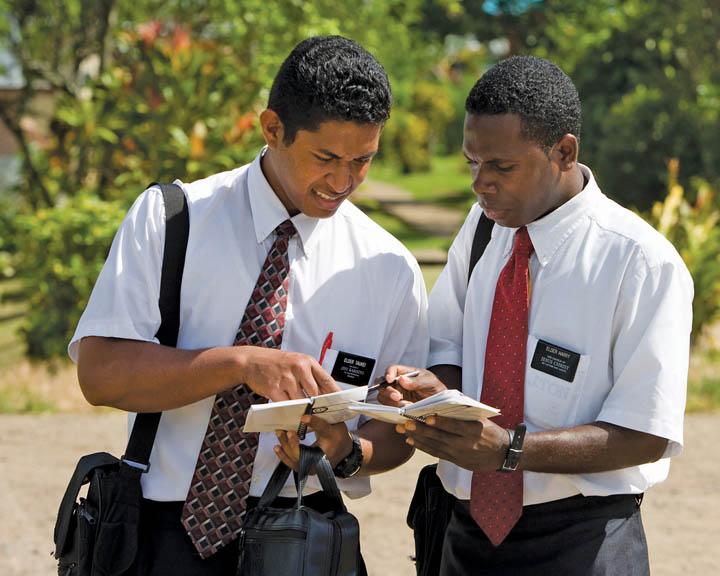
To be quite honest, I have struggled with whether I was very successful as a missionary or not. I served faithfully. But I wasn't immune to slacking a bit when I should have been street contacting.
I've never been much good at sales and its attendant skills. It was one thing to ring people's doorbells day after day, only to be turned away 99 out of 100 times. But I just hated accosting people on the street and talking to them about my religion.
I didn't mind being at a display where others initiated the conversation, even when they were simply there to argue. But initiating the contact without the kinds of safety barriers offered by doors or pavilions discombobulated me. I'm still that way when it comes to anything; even things that I feel strongly about.
If you measure missionary success by baptisms, I was not a successful missionary. But I suspect that the Lord measures success differently. This has repeatedly been impressed upon me as from afar I have watched my missionary son go through many of the same kinds of experiences I had back in the day.
So, what does Wright tell us are the keys to successful missionary work? Four of his eleven tips involve obedience. This might seem obsessive, but Wright says, "Obedience is the only frequency that the Spirit operates in." One cynical commenter says, "We are a church, not a corporation." I note, however, that Pres. Monson's premier speech at April general conference focused on obedience.
Wright claims, "You are unlikely to meet returned missionaries who were obedient but still regret their missions. But you will certainly encounter others who were never consistently obedient and never found the promised success and happiness." Anecdotally I'd say this seems right, but I don't know what a real study would find.
Wright's other tips include avoiding being judgmental, serving your companions, giving praise, loving others, exercising faith, loving your mission, and being yourself. One commenter adds that the willingness to work hard is indispensable.
 My score on these points as a missionary is a mixed bag. I did great at some and less so at others. I was likely so enamored over my callings to serve in various leadership positions that I couldn't look far enough outside of my me-box to properly love others as I should have. And let's just say that being judgmental has always been one of my stronger traits. (One that I have tried to tame.)
I particularly appreciate Wright's admonition to be yourself. Over my young life I had developed a mental image of what a good missionary was like. At the outset of my mission I tried very hard to follow every rule. I was very much a letter-of-the-law kind of guy. And I knew how to work hard.
In the MTC I became a Norwegian-learning, discussion-learning machine. (Yeah, we memorized the lessons back then.) In fact, some of my fellow missionaries as well as our instructors wondered if I was a machine and questioned whether I had any personality at all.
I continued trying to be the perfect missionary during my first month in Norway. Then I got a new companion. After a couple of weeks he sat me down and told me to lighten up. I still remember him saying, "Elder, God blessed you with a personality. You're not supposed to hide it under a bushel; you're supposed to let it out and use it to do his work. You've got to quit being a cardboard cutout of a missionary and show your gratitude to God by openly using the gifts he has given you."
A couple of weeks later, one of our investigators turned to my companion and asked, "What have you done to him? He used to be so stiff and now he's wonderful." I learned that reverence has its appropriate place and that excess rigidity stifles the Spirit. You don't have to have a long face to be spiritual.
No, I don't regret my mission at all. It was a magnificent experience that brought extremely valuable learning and experiences that could have come in no other way. I was far from the perfect missionary, but then again, who isn't?
Wright's list of missionary tips isn't exhaustive. And some points certainly seem more valuable than others. But you won't go wrong by following his advice.
What would your list of advice for full-time missionaries look like?
Wednesday, August 07, 2013
Callings By Inspiration VS Callings By Desperation
I have often heard LDS Church members half jokingly talk about callings by inspiration vs. callings by desperation. I once heard a sister after using those words say that every time she was called to fill a church position, she boldly confronted the calling authority demanding precisely how he knew she was supposed to receive the calling.
 I believe that this type of thinking represents a fundamental misunderstanding of the doctrine of callings in the church and what church leaders mean when they talk about callings coming from the Lord. It further misconstrues the doctrine of sustaining church members in their callings.
Article of Faith #5 states that church members "must be called of God, by prophecy ... by those who are in authority...." Handbook 2, section 19.1.1 states that "Leaders seek the guidance of the Spirit in determining whom to call."
No one should expect the spirit of prophecy and guidance from the Spirit to occur any differently for callings than it does on any other issue in life. Elder Dallin H. Oaks has an article in the August 2013 Ensign on the workings of revelation. His points include:
 Rather, it is entirely appropriate for you to prayerfully receive your own revelation regarding whether you are being called of God or not. And while leaders (being imperfect people) are not above reproach, directly challenging calling authorities as default behavior seems to fly in the face of the covenant to sustain them in their callings.
In line with Elder Oaks' teaching on the rarity of exceptional spiritual events, we should not expect that the bishop have the heavens opened to him every time he or one of his counselors calls a ward member to fill a position. Rather, we should expect overpowering revelation to be rare.
The bishop will have listened to the quiet whisperings of the Spirit that bring a sense of enlightenment and rightness to the calling. Or he will have moved forward using his best judgment, having not been told no by the Spirit. At least, that's how it has worked when I have served in callings where I was among those that have had responsibility for determining and issuing callings.
It really doesn't matter which spiritual method the Lord uses to help his servants develop church assignments; "whether by mine own voice or by the voice of my servants, it is the same" (D&C 1:38).
 It is acceptable to harbor some distrust of fallible humans that believe or act as if they have authority from God. For this reason, each church member has the ability to seek their own revelation regarding whether a calling comes from the Lord or not. After all, if you don't trust someone enough to properly issue a calling, why should you trust them to tell you how they received revelation? Go ahead and find out for yourself directly from the source. Such an answer could take time. It may even require working faithfully in the calling for a while.
I have had callings that I have loved and callings that I have hated. I have had callings that I initially hated that I learned to love. But every calling has been from the Lord, and fulfilling those callings to the best of my meager abilities has blessed my life beyond measure.
Releases come by inspiration from the Lord too. Years ago I both loved and hated my calling as scoutmaster. It was very fulfilling and I learned much. But support was hit-and-miss, making it difficult to effectively run a troop with nearly two dozen boys.
A couple of years into the calling I counseled with the bishop about some health problems I was experiencing related to my Multiple Sclerosis condition. After confidentially counseling with my wife about the matter, the bishop decided to replace me as scoutmaster (a process that took about three months). I had not asked to be released. I wanted to do the calling. But when the release came, I knew inside that it was right.
No doubt bishoprics sometimes find themselves scrambling to fill positions in the ward. Sometimes it can seem like callings occur out of desperation, even (especially?) to members of the bishopric. But when the process for seeking revelation as outlined by Elder Oaks is followed and callings (and releases) are properly handled, all will be in accordance with accepted doctrine, even if no spectacular heavenly manifestation has occurred. And of course, the person being called is fully authorized to receive and follow their own revelation on the matter, providing for a system of divine checks and balances.
Is a calling from the Lord? You decide. But in light of your covenants, you also are responsible for your decision. That is the Lord's way.
I believe that this type of thinking represents a fundamental misunderstanding of the doctrine of callings in the church and what church leaders mean when they talk about callings coming from the Lord. It further misconstrues the doctrine of sustaining church members in their callings.Article of Faith #5 states that church members "must be called of God, by prophecy ... by those who are in authority...." Handbook 2, section 19.1.1 states that "Leaders seek the guidance of the Spirit in determining whom to call."
No one should expect the spirit of prophecy and guidance from the Spirit to occur any differently for callings than it does on any other issue in life. Elder Dallin H. Oaks has an article in the August 2013 Ensign on the workings of revelation. His points include:
- Revelation comes to those that are qualified to receive it.
- Revelation comes on the Lord's timetable and in the Lord's way; not on our terms.
- Revelation most often comes when we are actively doing our part.
- Revelation often comes by enlightenment and peace (i.e. quiet whisperings) rather than in a bold manner. Exceptional spiritual events happen, but they are exceptional because they are rare.
- In the lack of clear direction we "are often obliged to act upon our best judgment, subject to the Spirit’s restraining impressions if we have strayed beyond permissible limits."

In line with Elder Oaks' teaching on the rarity of exceptional spiritual events, we should not expect that the bishop have the heavens opened to him every time he or one of his counselors calls a ward member to fill a position. Rather, we should expect overpowering revelation to be rare.
The bishop will have listened to the quiet whisperings of the Spirit that bring a sense of enlightenment and rightness to the calling. Or he will have moved forward using his best judgment, having not been told no by the Spirit. At least, that's how it has worked when I have served in callings where I was among those that have had responsibility for determining and issuing callings.
It really doesn't matter which spiritual method the Lord uses to help his servants develop church assignments; "whether by mine own voice or by the voice of my servants, it is the same" (D&C 1:38).

I have had callings that I have loved and callings that I have hated. I have had callings that I initially hated that I learned to love. But every calling has been from the Lord, and fulfilling those callings to the best of my meager abilities has blessed my life beyond measure.
Releases come by inspiration from the Lord too. Years ago I both loved and hated my calling as scoutmaster. It was very fulfilling and I learned much. But support was hit-and-miss, making it difficult to effectively run a troop with nearly two dozen boys.
A couple of years into the calling I counseled with the bishop about some health problems I was experiencing related to my Multiple Sclerosis condition. After confidentially counseling with my wife about the matter, the bishop decided to replace me as scoutmaster (a process that took about three months). I had not asked to be released. I wanted to do the calling. But when the release came, I knew inside that it was right.
No doubt bishoprics sometimes find themselves scrambling to fill positions in the ward. Sometimes it can seem like callings occur out of desperation, even (especially?) to members of the bishopric. But when the process for seeking revelation as outlined by Elder Oaks is followed and callings (and releases) are properly handled, all will be in accordance with accepted doctrine, even if no spectacular heavenly manifestation has occurred. And of course, the person being called is fully authorized to receive and follow their own revelation on the matter, providing for a system of divine checks and balances.
Is a calling from the Lord? You decide. But in light of your covenants, you also are responsible for your decision. That is the Lord's way.
Monday, August 05, 2013
How to Get Lost In the Wilderness
I recently spent time at a Boy Scout camp situated in a remote back country area. The director and program director told me the tale of a lost camper. This story thankfully has a happy ending. I will recite the story as I understand it.
A couple of weeks ago a man in his early 50s (old enough to know better) was at camp with his scout troop. His actions offer a textbook example of how to get lost in the back country. Here are the basic steps:
1) Don't tell anyone what you are doing or where you are going.
The man awoke early one beautiful morning and decided to do a little exploring. Not wanting to bother his fellow campers, he quietly slipped out of camp. He didn't bother to leave a note or anything like that because he wasn't going far. He would be back in time for breakfast.
2) Hike alone.
Since the man was only going a short distance outside of camp, he wouldn't need a buddy. Besides, no one was awake to go hiking with him and he was a relatively avid hiker.
3) Have no plan.
The man really didn't have a destination. He just wanted to explore some of the beautiful region near the camp.
4) Hike in an area with which you are unfamiliar.
Familiarity with the area was unnecessary, or so the man thought. After all, wouldn't he always be able to find the great depression in the landscape that denoted the location of the lake adjacent to the camp?
4a) For extra credit, make sure to hike in an area infested with bear wallows.
5) Take no navigational tools with you.
GPS. Map and compass. Why would such things be needed for such a short hike?
6) Take no provisions with you.
Why take food and extra water when you're going to be back in time for breakfast?
7) Once you realize you are lost make sure to keep hiking.
The man felt quite foolish the moment he realized he was lost because he knew that he had broken almost every hiking safety rule. Since he was on a roll, he decided to break one more. Rather than stay put, he kept hiking around. And around. And around in a circular pattern. Heck, the dense forest all looked the same. How was he to know he was going in circles? And where the heck was that lake?
Some eight hours after the man left, members of his unit came to the camp office and said that they hadn't seen the man all day. Thanks to an updated communication system, forest service rangers and county search and rescue crews were soon involved in the search. Since no one had any idea of what had happened, they began at the man's campsite and started branching out.
One crew came upon a black bear sow that was unusually aggressive. (These were people that were experienced in dealing with bears.) They assumed that she was guarding a carcass, perhaps that of the missing camper. Thankfully, that turned out not to be the case.
About 29 hours after the man first left camp, he was returned safely by a crew that had located him a mile and a half from one shore of the lake. Since he didn't stay put once he realized he was in trouble it took search crews extra time to find him.
Earlier in the summer the camp had (much more briefly) lost another camper who ended up being located by helicopter. As in the case above, many rules had been broken. But at least this camper had the excuse of being just a kid.
The wilderness is a beautiful but dangerous area. It really is infested with wild beasts that can be hazardous to humans. More so for humans that fail to follow basic safety procedures. But campers themselves are often their own worst enemies when it comes to back country safety.
The real rules are actually quite simple:
And if you do get lost, "hug a tree." Stay in one place. Make irregular sounding noises. Hiking whistles are nice, but the sound carries only so far. Whacking on a tree or a log can help, but only if you do it in a pattern that no one would suspect as being naturally occurring. Try to keep yourself in an area with some exposure so that you can more easily be seen by searchers.
Some have suggested starting a fire when lost. That can help if you make it smoky enough. But remember to use proper fire safety because burning down the forest is a bad idea even if it brings fire crews. Being lost is bad enough without having to try to escape from a wild fire that can move at speeds of up to 80 mph.
Of course, the number one rule is DON'T GET LOST! Countless hikers traverse the back country each season without getting lost. A few simple precautions can help ensure that you are not among the unfortunate few that do.
A couple of weeks ago a man in his early 50s (old enough to know better) was at camp with his scout troop. His actions offer a textbook example of how to get lost in the back country. Here are the basic steps:
1) Don't tell anyone what you are doing or where you are going.
The man awoke early one beautiful morning and decided to do a little exploring. Not wanting to bother his fellow campers, he quietly slipped out of camp. He didn't bother to leave a note or anything like that because he wasn't going far. He would be back in time for breakfast.
2) Hike alone.
Since the man was only going a short distance outside of camp, he wouldn't need a buddy. Besides, no one was awake to go hiking with him and he was a relatively avid hiker.
3) Have no plan.
The man really didn't have a destination. He just wanted to explore some of the beautiful region near the camp.
4) Hike in an area with which you are unfamiliar.
Familiarity with the area was unnecessary, or so the man thought. After all, wouldn't he always be able to find the great depression in the landscape that denoted the location of the lake adjacent to the camp?
4a) For extra credit, make sure to hike in an area infested with bear wallows.
5) Take no navigational tools with you.
GPS. Map and compass. Why would such things be needed for such a short hike?
6) Take no provisions with you.
Why take food and extra water when you're going to be back in time for breakfast?
7) Once you realize you are lost make sure to keep hiking.
The man felt quite foolish the moment he realized he was lost because he knew that he had broken almost every hiking safety rule. Since he was on a roll, he decided to break one more. Rather than stay put, he kept hiking around. And around. And around in a circular pattern. Heck, the dense forest all looked the same. How was he to know he was going in circles? And where the heck was that lake?
Some eight hours after the man left, members of his unit came to the camp office and said that they hadn't seen the man all day. Thanks to an updated communication system, forest service rangers and county search and rescue crews were soon involved in the search. Since no one had any idea of what had happened, they began at the man's campsite and started branching out.
One crew came upon a black bear sow that was unusually aggressive. (These were people that were experienced in dealing with bears.) They assumed that she was guarding a carcass, perhaps that of the missing camper. Thankfully, that turned out not to be the case.
About 29 hours after the man first left camp, he was returned safely by a crew that had located him a mile and a half from one shore of the lake. Since he didn't stay put once he realized he was in trouble it took search crews extra time to find him.
Earlier in the summer the camp had (much more briefly) lost another camper who ended up being located by helicopter. As in the case above, many rules had been broken. But at least this camper had the excuse of being just a kid.
The wilderness is a beautiful but dangerous area. It really is infested with wild beasts that can be hazardous to humans. More so for humans that fail to follow basic safety procedures. But campers themselves are often their own worst enemies when it comes to back country safety.
The real rules are actually quite simple:
- Have a plan for where you are headed and when you will be back. Share the plan with responsible parties (that are not hiking with you and can get help if you don't return on time).
- Take a buddy.
- Either hike in area familiar to you, hike with someone that is familiar with the area, or take navigational tools that you know how to use. Or all of the above.
- Take communication tools (if you have any hope of using them effectively).
- Avoid areas with high populations of dangerous animals (like bear wallows).
- Take extra provisions and water with you.
And if you do get lost, "hug a tree." Stay in one place. Make irregular sounding noises. Hiking whistles are nice, but the sound carries only so far. Whacking on a tree or a log can help, but only if you do it in a pattern that no one would suspect as being naturally occurring. Try to keep yourself in an area with some exposure so that you can more easily be seen by searchers.
Some have suggested starting a fire when lost. That can help if you make it smoky enough. But remember to use proper fire safety because burning down the forest is a bad idea even if it brings fire crews. Being lost is bad enough without having to try to escape from a wild fire that can move at speeds of up to 80 mph.
Of course, the number one rule is DON'T GET LOST! Countless hikers traverse the back country each season without getting lost. A few simple precautions can help ensure that you are not among the unfortunate few that do.
Tuesday, July 30, 2013
Missionaries, Flies, and Honey
The LDS Church has recently stepped up its missionary efforts. The lowering of the minimum age for young people to serve missions has led to a significant increase in the number of missionaries from about 52,000 to more than 70,000. Some estimates suggest that the number could peak at around 100,000.
The church has long emphasized that the responsibility for finding new investigators for the full-time missionaries to teach rests on the rank-and-file members. But this has not changed the fact that full-time missionaries spend most of their time finding new investigators rather than teaching. Without a change in the practices of the membership, adding more missionaries would mean missionaries spending yet more time finding people to teach.
The church recently invited stake and ward leaders to a two-hour broadcast called The Work of Salvation. The broadcast clearly conveyed the message that stake and ward councils have the primary responsibility of helping rank-and-file members fill the calendars of full-time missionaries with teaching appointments. They are to develop and carry out plans. The full-time missionaries are there to help the members fulfill their responsibilities.
Our son writes from overseas that this message has been received with marginal enthusiasm in the small branch where he is serving. Some of the branch leaders don't see themselves being much able to develop teaching prospects for the missionaries.
Last Sunday the full-time sister missionaries serving in our stake spoke in our ward sacrament meeting. They came to our area just recently and found little in the way of prospects. So they have been spending most of their time going door-to-door contacting people with little success.
The message these lovely sisters gave consisted mainly of 1) whining about long days of door-to-door contacting in the hot summer weather with poor results and 2) being critical of local church members for failing to adequately fill the sisters' appointment book. Unfortunately, it was kind of an "it's all about us" approach.
I have been a young missionary in a tough area. All of my areas in Norway were tough areas. We expended endless hours contacting people in an attempt to develop teaching appointments. These efforts were occasionally interspersed with actual teaching appointments. On extremely rare occasions, those appointments involved members inviting us to teach their friends, neighbors, or acquaintances. My companions and I saw a lot of work without much success. I understand what missionaries like my son and these sisters are experiencing.
But I have also been a rank-and-file church member for a long time. My neighbor that moved here from out of state said that he was surprised to discover that in Utah there is an unwritten social contract that says that LDS Church members generally refrain from overtly evangelizing about the church to others. While this takes the rough edges off social interactions, it tends to create an us-vs-them mentality for those in and out of the church. Active church members tend to socialize with active church members, so they don't have a lot of non-member or less active friends for the missionaries to teach.
The average Utah Mormon, when asked to think of friends and family members that could benefit from meeting with the missionaries, draws a blank. They all know people that should hear the Gospel message, but they also know that most of these people have already been approached plenty of times and have more or less indicated that they don't want to be bothered about it.
Our local sister missionaries said that church members often ask what they can do for the missionaries. The implication is that these members are willing to drive them places, feed them, supply clothing and other needs, etc. When the sisters respond, "Please give us some names of people we can teach," the members stammer, hem and haw.
Living in a predominantly LDS area, I can glance through all of the addresses in my ward and tell you who is active in the church, who is kind of active in the church, who is a member but is not currently active in the church, and who is not a member of the church. The missionaries could visit all of those in the latter two categories in our ward in one or two evenings without getting a teaching appointment. Multiply that by all of the wards in our stake and the missionaries could fill two to four weeks of evenings, likely without much success.
Another challenge where ward, stake, and missionary area boundaries are small is that the prospects members have often live outside of the missionary area where they live. Sometimes outside of the mission boundaries. This makes it hard to fill the local missionaries' calendars unless the prospects come to the member's home to be taught.
Yet another challenge is the fact that my entire stake is part of a bedroom community. People vacate the area to go to work, school and activities during the day, making it hard to provide daytime appointments for the missionaries. Evenings are busy as families grapple with church, community, school, and social commitments.
I'm not saying that missionary work is not possible where I live. I'm saying that an area like ours presents certain challenges to the kind of robust missionary work these sister missionaries would like to be doing. Members are not unwilling; they just don't know how to improve on what they are currently doing.
Given this situation, I feel that the good sister missionaries had a great message, but went about delivering it in a way that likely generated less cooperation rather than more. Instead of whining about tedious work and berating members for their inadequacies, it would probably have been better to focus on the joy and exhilaration that comes from sharing the gospel with friends and family, explaining ways to do that within the regular course of a busy life, and describing where the missionaries can help.
The old adage about honey attracting more flies than vinegar is applicable here. Helping members focus on the great blessings in store for them and encouraging them to feel that they can actually do the work is certain to bring a better response than complaining about the failure of people to achieve the ideal.
That's a lot to ask of young missionaries that are doing tedious and mundane work day after day without generating much interest in their message. After all, even the great missionary Paul was not immune to grousing and remonstrating on occasion. But he also gloried in his trials for Jesus' sake and frequently sent encouraging messages. I hope that our local sister missionaries, my son abroad, and other missionaries learn to use more honey and less vinegar when working with members.
The church has long emphasized that the responsibility for finding new investigators for the full-time missionaries to teach rests on the rank-and-file members. But this has not changed the fact that full-time missionaries spend most of their time finding new investigators rather than teaching. Without a change in the practices of the membership, adding more missionaries would mean missionaries spending yet more time finding people to teach.
The church recently invited stake and ward leaders to a two-hour broadcast called The Work of Salvation. The broadcast clearly conveyed the message that stake and ward councils have the primary responsibility of helping rank-and-file members fill the calendars of full-time missionaries with teaching appointments. They are to develop and carry out plans. The full-time missionaries are there to help the members fulfill their responsibilities.
Our son writes from overseas that this message has been received with marginal enthusiasm in the small branch where he is serving. Some of the branch leaders don't see themselves being much able to develop teaching prospects for the missionaries.
Last Sunday the full-time sister missionaries serving in our stake spoke in our ward sacrament meeting. They came to our area just recently and found little in the way of prospects. So they have been spending most of their time going door-to-door contacting people with little success.
The message these lovely sisters gave consisted mainly of 1) whining about long days of door-to-door contacting in the hot summer weather with poor results and 2) being critical of local church members for failing to adequately fill the sisters' appointment book. Unfortunately, it was kind of an "it's all about us" approach.
I have been a young missionary in a tough area. All of my areas in Norway were tough areas. We expended endless hours contacting people in an attempt to develop teaching appointments. These efforts were occasionally interspersed with actual teaching appointments. On extremely rare occasions, those appointments involved members inviting us to teach their friends, neighbors, or acquaintances. My companions and I saw a lot of work without much success. I understand what missionaries like my son and these sisters are experiencing.
But I have also been a rank-and-file church member for a long time. My neighbor that moved here from out of state said that he was surprised to discover that in Utah there is an unwritten social contract that says that LDS Church members generally refrain from overtly evangelizing about the church to others. While this takes the rough edges off social interactions, it tends to create an us-vs-them mentality for those in and out of the church. Active church members tend to socialize with active church members, so they don't have a lot of non-member or less active friends for the missionaries to teach.
The average Utah Mormon, when asked to think of friends and family members that could benefit from meeting with the missionaries, draws a blank. They all know people that should hear the Gospel message, but they also know that most of these people have already been approached plenty of times and have more or less indicated that they don't want to be bothered about it.
Our local sister missionaries said that church members often ask what they can do for the missionaries. The implication is that these members are willing to drive them places, feed them, supply clothing and other needs, etc. When the sisters respond, "Please give us some names of people we can teach," the members stammer, hem and haw.
Living in a predominantly LDS area, I can glance through all of the addresses in my ward and tell you who is active in the church, who is kind of active in the church, who is a member but is not currently active in the church, and who is not a member of the church. The missionaries could visit all of those in the latter two categories in our ward in one or two evenings without getting a teaching appointment. Multiply that by all of the wards in our stake and the missionaries could fill two to four weeks of evenings, likely without much success.
Another challenge where ward, stake, and missionary area boundaries are small is that the prospects members have often live outside of the missionary area where they live. Sometimes outside of the mission boundaries. This makes it hard to fill the local missionaries' calendars unless the prospects come to the member's home to be taught.
Yet another challenge is the fact that my entire stake is part of a bedroom community. People vacate the area to go to work, school and activities during the day, making it hard to provide daytime appointments for the missionaries. Evenings are busy as families grapple with church, community, school, and social commitments.
I'm not saying that missionary work is not possible where I live. I'm saying that an area like ours presents certain challenges to the kind of robust missionary work these sister missionaries would like to be doing. Members are not unwilling; they just don't know how to improve on what they are currently doing.
Given this situation, I feel that the good sister missionaries had a great message, but went about delivering it in a way that likely generated less cooperation rather than more. Instead of whining about tedious work and berating members for their inadequacies, it would probably have been better to focus on the joy and exhilaration that comes from sharing the gospel with friends and family, explaining ways to do that within the regular course of a busy life, and describing where the missionaries can help.
The old adage about honey attracting more flies than vinegar is applicable here. Helping members focus on the great blessings in store for them and encouraging them to feel that they can actually do the work is certain to bring a better response than complaining about the failure of people to achieve the ideal.
That's a lot to ask of young missionaries that are doing tedious and mundane work day after day without generating much interest in their message. After all, even the great missionary Paul was not immune to grousing and remonstrating on occasion. But he also gloried in his trials for Jesus' sake and frequently sent encouraging messages. I hope that our local sister missionaries, my son abroad, and other missionaries learn to use more honey and less vinegar when working with members.
Monday, July 29, 2013
Why Do Politicians Insist That They are Not Professionals?
Why is it so common for those engaged in the profession of politics to deny that they are professional politicians? In what other line of work do professionals assert that they are simply amateurs?
I guess this phenomenon also occurs at certain levels of athletics. While Olympic level competition has given way to openly admitting professional athletes, we continue to ridiculously insist that all collegiate athletes are amateurs. It might be somewhat common for drug pushers and prostitutes to deny that they are professionals to law enforcement officials, but probably not to their customers.
The denial of one's own professionalism is never or almost never seen in fields like medicine, education, business, entertainment, finance, technology, etc. Even if there were no laws about who could perform surgery, you wouldn't see some guy openly advertising that he wants to be your surgeon, despite being an amateur. But politicians do this kind of thing all of the time, asserting that they are political outsiders.
So what is different about politics, some athletics, and illegal activities that make people deny that they are professionals? It would seem that each of these parties has something to gain by such a denial. Crime professionals are obviously seeking leniency. College athletes are simply working within collegiate association rules that (wink, wink, nod, nod) seek to maintain an appearance of amateurism that all but the most gullible can easily see through.
Politicians assert non-professionalism to get voters and constituents to view the politician as one of their own—someone just like them that shares their same concerns and wants the same things. That is, they are attempting to blind their constituents to the reality that they have personal political incentives that dramatically differ from those that vote for them.
I once heard a local politician complain that he had many supporters when he was running for office that turned on him once he was elected. "I was their friend and hero when I was running against the incumbent. Now that I am in office they all treat me like the enemy," he said. "What is it about getting elected that turns someone into the enemy?" he asked.
While this politician couldn't understand the phenomenon, his erstwhile supporters did; at least subconsciously. They understood that once in office he would operate according to what he felt was best for him rather than what was best for them. He would discover, for example, that he had to grease the skids with the power brokers if he wanted any piece of legislation he created to have any chance of progressing.
The development of political relationships and the necessary exchange of favors creates incentives that ofttimes run counter to the interests of voters; although, the politician is expert at convincing himself that he is actually acting in the voters' best interests.
As long as these political activities do not raise too many hackles, the politician can hope to be re-elected or even elected to higher office. But the politician works in a dynamic system where things are constantly shifting. More than one politician has been surprised to have his career cut short when what he has always done suddenly hits the spotlight in a negative way due to factors beyond his control.
One of the common tools for hedging against this is for the politician to carefully market himself as a politically erudite amateur rather than a political professional. He doesn't have to really convince everyone that he is not a professional politician; just enough to ensure election.
A friend of mine ran for mayor when his city planned to widen the road adjacent to his home only on his side of the road. Much of his yard would have been consumed. Due to a number of factors, he ended up becoming mayor and having to learn what a mayor really does. Immersion in the political world was an eye opening experience. After getting his bearings, he found that he rather enjoyed it.
The voters booted my friend out of office the following election because they sensed that he had moved from concerned citizen to politician. Interestingly, he made a comeback four years later, posing once again as an outsider. But once back in office he again showed himself to be an insider. The voters demonstrated at the end of his second term that they had finally had enough of him.
Politicians don't always deny their profession. U.S. Senator Orrin Hatch, who initially ran as an outsider in 1976 garnered a seventh term mainly by running as an experienced Washington insider. The most adept politicians sense what the public wants to hear and market themselves accordingly.
Majestic rhetoric about politicians doing their civic duty is often bandied about to bolster the idea that politicians serve some kind of higher purpose than their constituents that spend their days working regular jobs and raising families. Some of the politicians might even believe it. But doing so will not stop them from acting in their own interest while in office, even if they tell themselves otherwise.
Political systems exist of necessity. Due to necessity they are staffed with politicians—politicians that act chiefly in their own interest. The wise voter will recognize these realities rather than believing mythical stories about political saints and saviors.
I guess this phenomenon also occurs at certain levels of athletics. While Olympic level competition has given way to openly admitting professional athletes, we continue to ridiculously insist that all collegiate athletes are amateurs. It might be somewhat common for drug pushers and prostitutes to deny that they are professionals to law enforcement officials, but probably not to their customers.
The denial of one's own professionalism is never or almost never seen in fields like medicine, education, business, entertainment, finance, technology, etc. Even if there were no laws about who could perform surgery, you wouldn't see some guy openly advertising that he wants to be your surgeon, despite being an amateur. But politicians do this kind of thing all of the time, asserting that they are political outsiders.
So what is different about politics, some athletics, and illegal activities that make people deny that they are professionals? It would seem that each of these parties has something to gain by such a denial. Crime professionals are obviously seeking leniency. College athletes are simply working within collegiate association rules that (wink, wink, nod, nod) seek to maintain an appearance of amateurism that all but the most gullible can easily see through.
Politicians assert non-professionalism to get voters and constituents to view the politician as one of their own—someone just like them that shares their same concerns and wants the same things. That is, they are attempting to blind their constituents to the reality that they have personal political incentives that dramatically differ from those that vote for them.
I once heard a local politician complain that he had many supporters when he was running for office that turned on him once he was elected. "I was their friend and hero when I was running against the incumbent. Now that I am in office they all treat me like the enemy," he said. "What is it about getting elected that turns someone into the enemy?" he asked.
While this politician couldn't understand the phenomenon, his erstwhile supporters did; at least subconsciously. They understood that once in office he would operate according to what he felt was best for him rather than what was best for them. He would discover, for example, that he had to grease the skids with the power brokers if he wanted any piece of legislation he created to have any chance of progressing.
The development of political relationships and the necessary exchange of favors creates incentives that ofttimes run counter to the interests of voters; although, the politician is expert at convincing himself that he is actually acting in the voters' best interests.
As long as these political activities do not raise too many hackles, the politician can hope to be re-elected or even elected to higher office. But the politician works in a dynamic system where things are constantly shifting. More than one politician has been surprised to have his career cut short when what he has always done suddenly hits the spotlight in a negative way due to factors beyond his control.
One of the common tools for hedging against this is for the politician to carefully market himself as a politically erudite amateur rather than a political professional. He doesn't have to really convince everyone that he is not a professional politician; just enough to ensure election.
A friend of mine ran for mayor when his city planned to widen the road adjacent to his home only on his side of the road. Much of his yard would have been consumed. Due to a number of factors, he ended up becoming mayor and having to learn what a mayor really does. Immersion in the political world was an eye opening experience. After getting his bearings, he found that he rather enjoyed it.
The voters booted my friend out of office the following election because they sensed that he had moved from concerned citizen to politician. Interestingly, he made a comeback four years later, posing once again as an outsider. But once back in office he again showed himself to be an insider. The voters demonstrated at the end of his second term that they had finally had enough of him.
Politicians don't always deny their profession. U.S. Senator Orrin Hatch, who initially ran as an outsider in 1976 garnered a seventh term mainly by running as an experienced Washington insider. The most adept politicians sense what the public wants to hear and market themselves accordingly.
Majestic rhetoric about politicians doing their civic duty is often bandied about to bolster the idea that politicians serve some kind of higher purpose than their constituents that spend their days working regular jobs and raising families. Some of the politicians might even believe it. But doing so will not stop them from acting in their own interest while in office, even if they tell themselves otherwise.
Political systems exist of necessity. Due to necessity they are staffed with politicians—politicians that act chiefly in their own interest. The wise voter will recognize these realities rather than believing mythical stories about political saints and saviors.
Monday, July 22, 2013
Returning to Civilization
I spent last week at Camp New Fork, a Boy Scout camp on the edge of the Wind River Range in Wyoming. I lost data coverage on my phone more than a dozen miles away from camp. I lost all coverage about three miles away from camp. All of the other adults with my troop continued to have both voice and data coverage in camp. But my employer-issued phone uses a sub par carrier. The first time I heard another leader's phone ring in camp I realized that being out of my provider's coverage area for a week was going to be a blessing.
Son #3, who has achieved the distinction of being the tallest member of the family (a title I believe he will maintain) participated in the camp's high adventure program. I spent the week shadowing my youngest son as he went to merit badge classes and activities. Despite serving as the troop's assistant senior patrol leader, his particular case of Asperger Syndrome renders it unlikely that he would complete all of the requirements for any badge without occasional one-on-one intervention. I sat around much of the time so that I could provide this assistance when needed.
Sometimes it's easy to know when to jump in. Other times, not so much. As I doggedly followed my son around the field archery range thinking that it should never be so hot in the mountains and cursing myself for leaving my water bottle at the campsite, I slowly learned to just stay in the background without offering any instruction or critique. Just making an occasional positive comment and helping retrieve arrows following each target turned out to be enough. Archery is a challenging merit badge. My son was on cloud nine when he completed the requirements at nearly the last possible minute on Friday afternoon. I remember his oldest brother doing something similar at Camp Aspen Ridge nine years ago.
We were pleasantly surprised at the low number of biting flies, something that is quite unusual for that area this time of year. I used repellent only once and sustained fewer than a dozen bites. But cattle range through the camp. They are mostly benign, except for the piles of excrement they leave behind and their frequent bellowing. Who knew that cows could be so darn loud (especially at night when you're trying to sleep)?
Most days were blazingly sunny and quite warm. Of course, we did get some rain. One evening we experienced a spectacular thunderstorm, complete with blinding lightening and torrents of rain. We stayed dry in our tent. The moisture reduced the dust for a day. Nights were cool and comfortable.
All of our 18 boys had a great time; although, I considered the program somewhat sub par compared to some other camps I have attended. Some of the more experienced staffers were away attending the BSA National Jamboree, leaving the staff short handed. After the Monday evening campfire, son #3, who has served on Camp Loll staff said, "That was no Camp Loll campfire program." How right he was. There were a number of faux pas throughout the week that belied a somewhat loosely run ship.
Still, the overall experience was pretty good. There was a troop in camp from Colorado and another from Reno. Despite the scout camp facilities available in their areas, both considered their Camp New Fork experience superior to their local camps.
I made friends with a strapping man in his 30s who had bold tattoos covering his arm. He offered some obviously expert archery advice to my son. The man is a Green Beret who was taking time away to spend a week at camp with his son. He described how he and his son stayed dry when they were camping at the other end of the lake on the overnight canoe hike when the thunderstorm hit. Scouting allows friendships like this to be built.
Camp New Fork has good quality dirt roads that run to each campsite and program area. The gate is kept closed, so access isn't open. But each troop gets to keep one vehicle parked at their campsite. This is a tremendous logistical benefit for loading, unloading, and storing scented items that are hard to store in the campsite bear box (such as grills greasy from years of scout camps).
When we finally got everything loaded up on Saturday morning, we headed home like horses heading back to the corral after being out on the trail. We made good time too. Until we ended up in a huge line of traffic stalled on I-80 due to a serious crash that killed two people. After waiting in 97° weather on the pavement for over an hour, we were diverted to a detour that consumed an additional hour, getting us home much later than expected. How grateful I was for the DVD system in my SUV that kept boys occupied during the delay.
Another week of scout summer camp is past. I have tried to count up all of the summer weeks I have spent at scout camps over the years. I think it's somewhere in the high 40s or maybe even low 50s. (That would be a year of scout summer camps.)
I am once again home. The gear is cleaned up and stowed. A number of boys have once again spent a week implementing the methods of scouting 24x7, hopefully further developing the character traits that lead to happy and virtuous lives. That, even more than the pleased look on my son's countenance as he told his mother of his triumphs at camp, is why I continue to go to scout camp.
Son #3, who has achieved the distinction of being the tallest member of the family (a title I believe he will maintain) participated in the camp's high adventure program. I spent the week shadowing my youngest son as he went to merit badge classes and activities. Despite serving as the troop's assistant senior patrol leader, his particular case of Asperger Syndrome renders it unlikely that he would complete all of the requirements for any badge without occasional one-on-one intervention. I sat around much of the time so that I could provide this assistance when needed.
Sometimes it's easy to know when to jump in. Other times, not so much. As I doggedly followed my son around the field archery range thinking that it should never be so hot in the mountains and cursing myself for leaving my water bottle at the campsite, I slowly learned to just stay in the background without offering any instruction or critique. Just making an occasional positive comment and helping retrieve arrows following each target turned out to be enough. Archery is a challenging merit badge. My son was on cloud nine when he completed the requirements at nearly the last possible minute on Friday afternoon. I remember his oldest brother doing something similar at Camp Aspen Ridge nine years ago.
We were pleasantly surprised at the low number of biting flies, something that is quite unusual for that area this time of year. I used repellent only once and sustained fewer than a dozen bites. But cattle range through the camp. They are mostly benign, except for the piles of excrement they leave behind and their frequent bellowing. Who knew that cows could be so darn loud (especially at night when you're trying to sleep)?
Most days were blazingly sunny and quite warm. Of course, we did get some rain. One evening we experienced a spectacular thunderstorm, complete with blinding lightening and torrents of rain. We stayed dry in our tent. The moisture reduced the dust for a day. Nights were cool and comfortable.
All of our 18 boys had a great time; although, I considered the program somewhat sub par compared to some other camps I have attended. Some of the more experienced staffers were away attending the BSA National Jamboree, leaving the staff short handed. After the Monday evening campfire, son #3, who has served on Camp Loll staff said, "That was no Camp Loll campfire program." How right he was. There were a number of faux pas throughout the week that belied a somewhat loosely run ship.
Still, the overall experience was pretty good. There was a troop in camp from Colorado and another from Reno. Despite the scout camp facilities available in their areas, both considered their Camp New Fork experience superior to their local camps.
I made friends with a strapping man in his 30s who had bold tattoos covering his arm. He offered some obviously expert archery advice to my son. The man is a Green Beret who was taking time away to spend a week at camp with his son. He described how he and his son stayed dry when they were camping at the other end of the lake on the overnight canoe hike when the thunderstorm hit. Scouting allows friendships like this to be built.
Camp New Fork has good quality dirt roads that run to each campsite and program area. The gate is kept closed, so access isn't open. But each troop gets to keep one vehicle parked at their campsite. This is a tremendous logistical benefit for loading, unloading, and storing scented items that are hard to store in the campsite bear box (such as grills greasy from years of scout camps).
When we finally got everything loaded up on Saturday morning, we headed home like horses heading back to the corral after being out on the trail. We made good time too. Until we ended up in a huge line of traffic stalled on I-80 due to a serious crash that killed two people. After waiting in 97° weather on the pavement for over an hour, we were diverted to a detour that consumed an additional hour, getting us home much later than expected. How grateful I was for the DVD system in my SUV that kept boys occupied during the delay.
Another week of scout summer camp is past. I have tried to count up all of the summer weeks I have spent at scout camps over the years. I think it's somewhere in the high 40s or maybe even low 50s. (That would be a year of scout summer camps.)
I am once again home. The gear is cleaned up and stowed. A number of boys have once again spent a week implementing the methods of scouting 24x7, hopefully further developing the character traits that lead to happy and virtuous lives. That, even more than the pleased look on my son's countenance as he told his mother of his triumphs at camp, is why I continue to go to scout camp.
Sunday, July 14, 2013
As cold waters to a thirsty soul, so is good news from a far country
A few weeks ago our missionary son, who is serving half a world away sent an interesting message. He and his companion went to the branch chapel to meet with a church member and an investigator. When they arrived they found a note written in English attached to the door from an American church member that happened to be traveling in the area. The note said that he said that he would return in an hour or so.
While our son was at the chapel, the American walked in. He had been spending summer semester studying in a neighboring country. After completing his coursework, he decided to travel to the city from which his ancestors hailed, which happened to be where our son is serving. The man, known as KC had served a mission in yet another country and spoke a different foreign language. But he didn't let that deter him from traveling in the area.
The missionaries and church members were able to direct KC to the places he was most interested visiting. He also joined my son and his companion from time to time over the succeeding days in doing missionary work. On one occasion KC was able to teach a fellow from yet a different country that happened to speak the same foreign language as him.
Our son excitedly sent pictures of KC and himself, explaining that KC was from our town and had graduated from the same high school as him. Despite a few years age difference, KC and our son had a number of common acquaintances.
A couple of nights ago, a tall young man came to our door and introduced himself as KC. We were thrilled to invite him into our home. He told us about his visit to the town where our son is serving and told us about how our son is doing. We spent about an hour talking with him, even showing him pictures from my son's mission and having him tell us who some of the people in the pictures were.
Perhaps only a missionary parent can understand what kind of joy this tender mercy brought us. The title of this post quotes Proverbs 25:25. Indeed, KC's visit to our family was like cold waters to thirsty souls.
While our son was at the chapel, the American walked in. He had been spending summer semester studying in a neighboring country. After completing his coursework, he decided to travel to the city from which his ancestors hailed, which happened to be where our son is serving. The man, known as KC had served a mission in yet another country and spoke a different foreign language. But he didn't let that deter him from traveling in the area.
The missionaries and church members were able to direct KC to the places he was most interested visiting. He also joined my son and his companion from time to time over the succeeding days in doing missionary work. On one occasion KC was able to teach a fellow from yet a different country that happened to speak the same foreign language as him.
Our son excitedly sent pictures of KC and himself, explaining that KC was from our town and had graduated from the same high school as him. Despite a few years age difference, KC and our son had a number of common acquaintances.
A couple of nights ago, a tall young man came to our door and introduced himself as KC. We were thrilled to invite him into our home. He told us about his visit to the town where our son is serving and told us about how our son is doing. We spent about an hour talking with him, even showing him pictures from my son's mission and having him tell us who some of the people in the pictures were.
Perhaps only a missionary parent can understand what kind of joy this tender mercy brought us. The title of this post quotes Proverbs 25:25. Indeed, KC's visit to our family was like cold waters to thirsty souls.
Wednesday, July 10, 2013
Utah's High Teen Binge Drinking Rate Is Really a Low Binge Drinking Rate
News corporations like to foster the perception that they are all about objectivity and truth. In fact, all news organizations operate with a profit motive just like any other corporation. They slant, twist, embellish, and selectively report matters in ways designed to help them achieve greater profit. This is true as well for "nonprofit news organizations" that simply measure profit in in non-monetary terms.
A good example of sensationalistic misreporting was published in an AP News article published by the Standard Examiner under the title Less Utah teens drink booze, but those who do drink more.
We soon learn that this conclusion is drawn from a nationwide survey of high school seniors asking whether they drank alcohol in the last month and whether they engaged in binge drinking in the last month. But the shoddy reporting tells us nothing about how many teens were surveyed, the survey methodology, who commissioned the study (only that it was recently presented to Utah's Department of Alcoholic Beverage Control), the margin of error, or whether the survey has a history so as to reveal trends. Without this information you really know nothing about the validity of the numbers reported.
We learn in paragraph three that "of those Utah seniors who reported drinking, 72 percent said they had been binge drinking in the past month. That's significantly higher than the national average of 55 percent." That sounds pretty bad.
But wait. In paragraph two we learned that 17% of surveyed Utah high school seniors said that had drunk alcohol in the last month, compared to the national average of 40%. Let's apply some math to see how that actually works out.
U.S.: 40% * 55% = 22.00%
Utah: 17% * 72% = 12.24%
In other words, the national average of high school seniors that engage in binge drinking is nearly double Utah's rate. But the editor and the reporter chose to give the numbers a bad slant rather than a good slant. Why not? Sensationalism sells. I keep hearing Don Henley's 1982 song Dirty Laundry going through my head.
Of course, it could be that journalists are just bad at math. Or that teen binge drinking does not vary in direct proportion to teen alcohol consumption. Or that Utah high school seniors lie about their drinking habits at a higher rate than the national average. Self reporting is a notoriously faulty method of data gathering. But the numbers reported are not out of line with Utah's observable overall low rate of alcohol consumption, which most researchers feel is closely tied to social and cultural factors.
I'm not going to hold my breath waiting for news corporations to truly report straight news. Doing so generally runs counter to their ideological, financial, and power motives. But it pays to be aware of this so that one can better balance the 'news' that comes their way.
Monday, July 08, 2013
(Ir)Reverence, Please
We hold kneeling prayer together as a family every evening. We started this practice when we were first married and it has evolved over the years into a somewhat formal activity.
A wheel chart on the wall that tells whose turn it is to act as voice for the prayer. We begin by singing a religious song selected by whoever acted as voice for the previous evening's prayer. We kneel in a circle and hold hands as the prayer is voiced. Then we turn in our scriptures to where we left off the previous evening and each of us takes a turn reading a column. Then people go to bed.
Or more accurately, I go to bed. I get up in the wee hours of the morning to exercise before heading to my job, arriving at work before most people's alarms have gone off. Consequently I turn into a pumpkin pretty early in the evening.
I'm sure this makes it appear that our family is very spiritual. And on occasion we are. But more often our preparations for our evening devotional as well as the devotional itself are peppered with a great deal of irreverence, sniping, and decidedly un-Christ-like activities.
Half of the time the song picker takes longer to select a song than it takes to sing it. Or a song is picked that not everyone knows well enough to sing from memory. Or a song is selected that people are tired of singing. I mean, how often can you sing the Wise Man and the Foolish Man before you tire of it?
Despite my wish that everyone stay put during devotionals, family members continually develop excuses for wandering in and out of the family room during the event. People talk over each other or have private conversations during scripture reading. People (especially the youngest two) stare daggers at each other and make unkind remarks under their breath. Parents are sometimes overly critical of children that may be tired and cross. The list goes on.
I am relieved that even apostles have had similar challenges in their families. See Elder David A. Bednar's October 2009 general conference talk where he quotes his sons saying things like “He’s touching me!” “Make him stop looking at me!” “Mom, he’s breathing my air!” during family devotionals.
Quite frankly, sometimes I'm part of the problem. That was the case last night; although, this time my contribution was unwitting.
After finally getting everyone into the circle, one child brazenly broke wind. This resulted in gales of laughter from some family members and dramatic whole body recoils of disgust from others. As the cacophony died down, a second child boisterously contributed another dose of flatulence, eliciting laughter as well as drama worthy of a Shakespearean death scene.
As all of the hilarity and theatrics died down, I dispensed with my repeated calls for reverence and went to more direct instruction. "Close your eyes, close your mouths," and then referencing the recent gaseous outbursts I added, "close your butts."
I intended my admonition to be forthright with a slightly stern edge. However, it had the opposite effect. All of the other family members broke out in peals of laughter, as if I had said the funniest words ever spoken. I expressed my confusion as family members dabbed laughter tears from the corners of their eyes.
We eventually did get around to having family prayer and scripture study. Despite some irreverence during scripture reading, we actually had some decent discussion.
But, yeah, that's what family prayer is like at our house. Reverence is more like a journey than a destination—a journey whose end seems perpetually beyond the horizon.
Still, I hope that a lifetime of family prayer and scripture study will eventually, as Elder Bednar suggests, paint a good and worthy picture in the heart of each family member. With God as the master painter, how can it not?
A wheel chart on the wall that tells whose turn it is to act as voice for the prayer. We begin by singing a religious song selected by whoever acted as voice for the previous evening's prayer. We kneel in a circle and hold hands as the prayer is voiced. Then we turn in our scriptures to where we left off the previous evening and each of us takes a turn reading a column. Then people go to bed.
Or more accurately, I go to bed. I get up in the wee hours of the morning to exercise before heading to my job, arriving at work before most people's alarms have gone off. Consequently I turn into a pumpkin pretty early in the evening.
I'm sure this makes it appear that our family is very spiritual. And on occasion we are. But more often our preparations for our evening devotional as well as the devotional itself are peppered with a great deal of irreverence, sniping, and decidedly un-Christ-like activities.
Half of the time the song picker takes longer to select a song than it takes to sing it. Or a song is picked that not everyone knows well enough to sing from memory. Or a song is selected that people are tired of singing. I mean, how often can you sing the Wise Man and the Foolish Man before you tire of it?
Despite my wish that everyone stay put during devotionals, family members continually develop excuses for wandering in and out of the family room during the event. People talk over each other or have private conversations during scripture reading. People (especially the youngest two) stare daggers at each other and make unkind remarks under their breath. Parents are sometimes overly critical of children that may be tired and cross. The list goes on.
I am relieved that even apostles have had similar challenges in their families. See Elder David A. Bednar's October 2009 general conference talk where he quotes his sons saying things like “He’s touching me!” “Make him stop looking at me!” “Mom, he’s breathing my air!” during family devotionals.
Quite frankly, sometimes I'm part of the problem. That was the case last night; although, this time my contribution was unwitting.
After finally getting everyone into the circle, one child brazenly broke wind. This resulted in gales of laughter from some family members and dramatic whole body recoils of disgust from others. As the cacophony died down, a second child boisterously contributed another dose of flatulence, eliciting laughter as well as drama worthy of a Shakespearean death scene.
As all of the hilarity and theatrics died down, I dispensed with my repeated calls for reverence and went to more direct instruction. "Close your eyes, close your mouths," and then referencing the recent gaseous outbursts I added, "close your butts."
I intended my admonition to be forthright with a slightly stern edge. However, it had the opposite effect. All of the other family members broke out in peals of laughter, as if I had said the funniest words ever spoken. I expressed my confusion as family members dabbed laughter tears from the corners of their eyes.
We eventually did get around to having family prayer and scripture study. Despite some irreverence during scripture reading, we actually had some decent discussion.
But, yeah, that's what family prayer is like at our house. Reverence is more like a journey than a destination—a journey whose end seems perpetually beyond the horizon.
Still, I hope that a lifetime of family prayer and scripture study will eventually, as Elder Bednar suggests, paint a good and worthy picture in the heart of each family member. With God as the master painter, how can it not?
Wednesday, July 03, 2013
An Increasingly Crowded Hometown Fourth
I can't remember the first time I attended the Independence Day parade in my town. The town has held it every year since a generation before I was born. For as long as I can remember the day's festivities have included activities in one of the city parks. The city hosts a full day of events starting with an early morning flag ceremony (where they always fire canon) and wrapping up with fireworks in the evening.
The summer I was 14 I marched with the high school marching band in the parade in the morning. Thinking back to how we sweltered in our formal black wool band uniforms, I am pleased to see that the bands nowadays dress far more appropriately for the summer temperatures.
Later that day I wanted to go to the activities in the park. But I couldn't find anyone to go with me. My two older brothers were away working in Hawaii. Two years later I would spend the summer planting pineapples in Hawaii, but that summer life was free and easy. Except for marching band practice many mornings and newspaper delivery in the afternoons.
My younger brother had other things he wanted to do that day and most of my friends were out of town. But I had newspaper delivery earnings to burn. So I hopped on my bike and rode a mile to to the park. It was the first time I had attended this event without being accompanied by family members.
I wasn't much interested in the annual baseball tournament. I was too big for the kiddie attractions. But I was intrigued by the food and by the event where the patrons paid a fee to bash up an old car with a sledge hammer. As I wandered through the attractions in the shade of the trees behind the baseball grandstand, I saw an artist drawing caricatures of people. I paid the princely sum of $5 for a cartoon image of me skiing.
Then I saw a stand where people were buying lemons with stick candy protruding from the fruit. The vendors would cut a hole in the lemon skin through which the stick candy was inserted. I was surprised to discover that lemon juice could be drawn through the stick candy like a drinking straw. You just kept squeezing the lemon and sucking the artificially sweetened naturally sour acidic liquid until the juice was gone. Then you'd eat the candy.
I'm not sure why that particular Fourth of July event stands out in my mind. After all, I have attended various of the city's Independence Day activities throughout my life. Sometimes I have been volunteering and other times I have simply been accompanying my kids. Maybe that year was something of a coming of age thing for me.
Another memorable Fourth of July was when our then four-year-old (whom we call our wandering child) got lost among the crowds at the parade. Thanks to former neighbors that recognized the family resemblance, we were reunited with our wanderer within 15 minutes. But that was a harrowing quarter of an hour.
Our town celebration still has a hometown atmosphere about it. In fact, that is the comment I hear most frequently from nonresidents that come to these festivities. They note that the parade consists mostly of offerings by local schools, businesses, and organizations, with only an occasional parade float. They find the Dutch oven cooking contest and the homegrown kiddie games charming.
While I don't begrudge others coming to our town to drink in the feeling, the sheer numbers of those that do so render the celebration less inviting. Parking for these events has become nightmarish. My family solves this problem by walking or cycling to the various venues. But once there, the press of the crowd limits enjoyment and threatens to sweep away the bucolic charm of which many attendees claim to be enamored. Maybe the problem is that I'm just not much of a crowd person.
I don't know whether I will end up at the parade tomorrow morning. That depends largely upon whether my youngest son goes back to bed (and how long he stays there) after we put up flags in the neighborhood early in the morning. I am not slated to volunteer at any of the other events this year, and we can easily enjoy the fireworks from our home after taking down flags in the evening. Depending on what the children want to do, we may end up avoiding the crowds altogether tomorrow.
The summer I was 14 I marched with the high school marching band in the parade in the morning. Thinking back to how we sweltered in our formal black wool band uniforms, I am pleased to see that the bands nowadays dress far more appropriately for the summer temperatures.
Later that day I wanted to go to the activities in the park. But I couldn't find anyone to go with me. My two older brothers were away working in Hawaii. Two years later I would spend the summer planting pineapples in Hawaii, but that summer life was free and easy. Except for marching band practice many mornings and newspaper delivery in the afternoons.
My younger brother had other things he wanted to do that day and most of my friends were out of town. But I had newspaper delivery earnings to burn. So I hopped on my bike and rode a mile to to the park. It was the first time I had attended this event without being accompanied by family members.
I wasn't much interested in the annual baseball tournament. I was too big for the kiddie attractions. But I was intrigued by the food and by the event where the patrons paid a fee to bash up an old car with a sledge hammer. As I wandered through the attractions in the shade of the trees behind the baseball grandstand, I saw an artist drawing caricatures of people. I paid the princely sum of $5 for a cartoon image of me skiing.
Then I saw a stand where people were buying lemons with stick candy protruding from the fruit. The vendors would cut a hole in the lemon skin through which the stick candy was inserted. I was surprised to discover that lemon juice could be drawn through the stick candy like a drinking straw. You just kept squeezing the lemon and sucking the artificially sweetened naturally sour acidic liquid until the juice was gone. Then you'd eat the candy.
I'm not sure why that particular Fourth of July event stands out in my mind. After all, I have attended various of the city's Independence Day activities throughout my life. Sometimes I have been volunteering and other times I have simply been accompanying my kids. Maybe that year was something of a coming of age thing for me.
Another memorable Fourth of July was when our then four-year-old (whom we call our wandering child) got lost among the crowds at the parade. Thanks to former neighbors that recognized the family resemblance, we were reunited with our wanderer within 15 minutes. But that was a harrowing quarter of an hour.
Our town celebration still has a hometown atmosphere about it. In fact, that is the comment I hear most frequently from nonresidents that come to these festivities. They note that the parade consists mostly of offerings by local schools, businesses, and organizations, with only an occasional parade float. They find the Dutch oven cooking contest and the homegrown kiddie games charming.
While I don't begrudge others coming to our town to drink in the feeling, the sheer numbers of those that do so render the celebration less inviting. Parking for these events has become nightmarish. My family solves this problem by walking or cycling to the various venues. But once there, the press of the crowd limits enjoyment and threatens to sweep away the bucolic charm of which many attendees claim to be enamored. Maybe the problem is that I'm just not much of a crowd person.
I don't know whether I will end up at the parade tomorrow morning. That depends largely upon whether my youngest son goes back to bed (and how long he stays there) after we put up flags in the neighborhood early in the morning. I am not slated to volunteer at any of the other events this year, and we can easily enjoy the fireworks from our home after taking down flags in the evening. Depending on what the children want to do, we may end up avoiding the crowds altogether tomorrow.
Sunday, June 30, 2013
Burgers and Blessings
We cruised down I-15 toward the MTC. We planned to get lunch along the way and had scheduled enough time to stop for photos and last minute good-byes. It was sunny and relatively warm for November.
Through the rear view mirror I examined my son in the back seat of the car, looking for signs of anxiety. Decades earlier when I had made the same trip with my parents my father told me to lighten up because I was acting like a soldier right before going into combat for the first time. After all, many thousands had survived the MTC just fine. My son seemed to be in a state of heightened awareness, but didn't seem overly anxious.
My wife suddenly realized that she had failed to get postage stamps and stationary for our son. Seeing as she wanted him to write home—you know how moms are—we had to make a stop. I noticed an office supply store that was easily accessible from the adjacent freeway exit. I took the exit and drove to the store. It didn't take long to secure the needed supplies.
We then figured that it would work best if we ate lunch in that vicinity rather than making a second stop. We asked our son to pick from the multiple nearby dining establishments. He saw a Five Guys Burgers and Fries across the parking lot and he suddenly had a hankering for a gourmet burger.
Upon entering the burger place I saw a fellow that I recognized sitting down to lunch. But I couldn't quite place him. His face lit up as he asked, "Are you ... ?" We began an enjoyable chat. In the meantime we got our order and sat down to dine.
As we ate, our friend turned to my son and said, "I need to tell you a story about your grandfather." He explained that he suddenly felt that it was important for my son to hear this message. Years earlier as a teenager this man had visited my father to receive a patriarchal blessing.
At that time the young man was had been steadily dating a girl for quite awhile. Everyone in both of their families assumed that the two of them would someday wed. Indeed, during the blessing my father voiced some things about this man's future wife that seemed to apply to the young man's girlfriend. Among these comments was that the man's future wife was being raised in an "inactive" family. Indeed, his girlfriend was the only active church member among her immediate family members.
The following day the young man left on a long planned trip to Europe with an educational group. During the trip he became good friends with a young lady he had never previously met. His new friendship caused him to question facets of his relationship with his girlfriend.
During the young man's absence, my father delivered a printed copy of the patriarchal blessing to the young man's home. Soon after the young man returned home, he read this copy and was surprised to see that some of the wording regarding his future spouse had changed. Among other things, it said that she was being raised in a "loving" family rather than an inactive family. Other subtle changes made for a picture that didn't seem to match his girlfriend as much.
The changes bothered the young man so much that he visited my father and asked about it. Dad explained that English was not his native tongue, so that the words he said while speaking the blessing were not always the best fit for what the Spirit had spoken to his heart. He also said that a patriarch is allowed to receive revelation while preparing the printed copy of the blessing. Dad said that by the time he delivered the final copy, he was certain that the words were a close match for what the Spirit had told him.
Before long, this young man left to serve as a missionary for the church. The relationship with his girlfriend ended up not working out (as is often the case for missionaries that leave a girlfriend behind). About a year after returning from his mission, he ran into the girl he had met on his trip to Europe. They began dating and eventually married. He said that her family members were among the most loving people he had ever met.
As the story and our lunch wrapped up, the man told my son that he had no idea why he felt so strongly that my son needed to hear that story; only that it was important. As we climbed into the car, I wondered about the 'coincidence' of ending up in the same restaurant as this man so far from our homes. My son saw it as a tender mercy from the Lord.
Through the rear view mirror I examined my son in the back seat of the car, looking for signs of anxiety. Decades earlier when I had made the same trip with my parents my father told me to lighten up because I was acting like a soldier right before going into combat for the first time. After all, many thousands had survived the MTC just fine. My son seemed to be in a state of heightened awareness, but didn't seem overly anxious.
My wife suddenly realized that she had failed to get postage stamps and stationary for our son. Seeing as she wanted him to write home—you know how moms are—we had to make a stop. I noticed an office supply store that was easily accessible from the adjacent freeway exit. I took the exit and drove to the store. It didn't take long to secure the needed supplies.
We then figured that it would work best if we ate lunch in that vicinity rather than making a second stop. We asked our son to pick from the multiple nearby dining establishments. He saw a Five Guys Burgers and Fries across the parking lot and he suddenly had a hankering for a gourmet burger.
Upon entering the burger place I saw a fellow that I recognized sitting down to lunch. But I couldn't quite place him. His face lit up as he asked, "Are you ... ?" We began an enjoyable chat. In the meantime we got our order and sat down to dine.
As we ate, our friend turned to my son and said, "I need to tell you a story about your grandfather." He explained that he suddenly felt that it was important for my son to hear this message. Years earlier as a teenager this man had visited my father to receive a patriarchal blessing.
At that time the young man was had been steadily dating a girl for quite awhile. Everyone in both of their families assumed that the two of them would someday wed. Indeed, during the blessing my father voiced some things about this man's future wife that seemed to apply to the young man's girlfriend. Among these comments was that the man's future wife was being raised in an "inactive" family. Indeed, his girlfriend was the only active church member among her immediate family members.
The following day the young man left on a long planned trip to Europe with an educational group. During the trip he became good friends with a young lady he had never previously met. His new friendship caused him to question facets of his relationship with his girlfriend.
During the young man's absence, my father delivered a printed copy of the patriarchal blessing to the young man's home. Soon after the young man returned home, he read this copy and was surprised to see that some of the wording regarding his future spouse had changed. Among other things, it said that she was being raised in a "loving" family rather than an inactive family. Other subtle changes made for a picture that didn't seem to match his girlfriend as much.
The changes bothered the young man so much that he visited my father and asked about it. Dad explained that English was not his native tongue, so that the words he said while speaking the blessing were not always the best fit for what the Spirit had spoken to his heart. He also said that a patriarch is allowed to receive revelation while preparing the printed copy of the blessing. Dad said that by the time he delivered the final copy, he was certain that the words were a close match for what the Spirit had told him.
Before long, this young man left to serve as a missionary for the church. The relationship with his girlfriend ended up not working out (as is often the case for missionaries that leave a girlfriend behind). About a year after returning from his mission, he ran into the girl he had met on his trip to Europe. They began dating and eventually married. He said that her family members were among the most loving people he had ever met.
As the story and our lunch wrapped up, the man told my son that he had no idea why he felt so strongly that my son needed to hear that story; only that it was important. As we climbed into the car, I wondered about the 'coincidence' of ending up in the same restaurant as this man so far from our homes. My son saw it as a tender mercy from the Lord.
Wednesday, June 26, 2013
Pardon Me, but You Need a Blessing
It kept niggling in the back of my mind during worship services. I couldn't escape the feeling that this man needed help. But what could I do?
Earlier that day I had run into the father of a family that I home taught. This industrious, normally placid fellow was frustrated. More than that, I sensed anguish in his soul as he grappled with matters beyond his control. Half a world away his missionary child was dealing with a newly diagnosed chronic disease. The love and concern this father felt was running up against the obstacles of time zones and bureaucracy.
During priesthood meeting it became very clear to me that this brother needed a priesthood blessing. The clarity, calm, love, and warmth that washed over me were unmistakable. Given the repeated counsel to act promptly on direction from the Holy Spirit, I knew that I needed to take care of the matter that day.
But thinking about approaching this man made me feel rather awkward. He held an influential leadership position. He had close associates with whom he served and worthy adult sons that could and would readily perform the ordinance. While I was his home teacher, I certainly didn't have the close relationship with him that these others had. Besides, he would be busy in meetings throughout the day as part of his calling. When could I even talk to him?
As I was tempted to rationalize away the responsibility I felt had been placed upon me, I realized that later in the day this brother and I would end up at the same meeting. I arrived early and saw him speaking with one of his close associates. I was pleased to note that his wife was also in attendance.
As the brother wrapped up his conversation I broke in and asked if he had received a priesthood blessing. It felt socially uncomfortable, but spiritually right in a powerful way. At first this man looked at me with obvious surprise. I explained that I had repeatedly felt since our conversation earlier in the day that he needed a priesthood blessing and that his wife ought to receive one as well. I said that one of his sons or close associates could take care of the matter or that I would be happy to do so as his home teacher.
The man became thoughtful and suggested that we go to his office immediately following the meeting. I invited the associate with whom he had been speaking to accompany us. I felt so good throughout the meeting. I knew I had done the right thing and that good would come of it. I received whisperings of the words I should speak.
After the meeting I and the man I had invited blessed this priesthood leader. It was a powerful spiritual and emotional experience. There were few dry eyes in the room. The other two of us then joined this man as he blessed his wife. He almost couldn't speak at first, choking with loving emotion. Then he spoke mighty words of spiritual comfort as tears rolled down his cheeks.
The whole experience lasted only a few minutes. Then we all went our separate ways, changed for the better. While I often fail to do what I should, this time I knew I had done the right thing. Church leaders have problems and need help from time to time too. Despite social awkwardness, it felt good to know that I had allowed myself to be an instrument in helping calm an anguished soul.
Earlier that day I had run into the father of a family that I home taught. This industrious, normally placid fellow was frustrated. More than that, I sensed anguish in his soul as he grappled with matters beyond his control. Half a world away his missionary child was dealing with a newly diagnosed chronic disease. The love and concern this father felt was running up against the obstacles of time zones and bureaucracy.
During priesthood meeting it became very clear to me that this brother needed a priesthood blessing. The clarity, calm, love, and warmth that washed over me were unmistakable. Given the repeated counsel to act promptly on direction from the Holy Spirit, I knew that I needed to take care of the matter that day.
But thinking about approaching this man made me feel rather awkward. He held an influential leadership position. He had close associates with whom he served and worthy adult sons that could and would readily perform the ordinance. While I was his home teacher, I certainly didn't have the close relationship with him that these others had. Besides, he would be busy in meetings throughout the day as part of his calling. When could I even talk to him?
As I was tempted to rationalize away the responsibility I felt had been placed upon me, I realized that later in the day this brother and I would end up at the same meeting. I arrived early and saw him speaking with one of his close associates. I was pleased to note that his wife was also in attendance.
As the brother wrapped up his conversation I broke in and asked if he had received a priesthood blessing. It felt socially uncomfortable, but spiritually right in a powerful way. At first this man looked at me with obvious surprise. I explained that I had repeatedly felt since our conversation earlier in the day that he needed a priesthood blessing and that his wife ought to receive one as well. I said that one of his sons or close associates could take care of the matter or that I would be happy to do so as his home teacher.
The man became thoughtful and suggested that we go to his office immediately following the meeting. I invited the associate with whom he had been speaking to accompany us. I felt so good throughout the meeting. I knew I had done the right thing and that good would come of it. I received whisperings of the words I should speak.
After the meeting I and the man I had invited blessed this priesthood leader. It was a powerful spiritual and emotional experience. There were few dry eyes in the room. The other two of us then joined this man as he blessed his wife. He almost couldn't speak at first, choking with loving emotion. Then he spoke mighty words of spiritual comfort as tears rolled down his cheeks.
The whole experience lasted only a few minutes. Then we all went our separate ways, changed for the better. While I often fail to do what I should, this time I knew I had done the right thing. Church leaders have problems and need help from time to time too. Despite social awkwardness, it felt good to know that I had allowed myself to be an instrument in helping calm an anguished soul.
Wednesday, June 19, 2013
Imported Initiative
At five years of age my aunt was shocked when her school teacher said that she couldn't speak English. Well, of course she could speak English. She could readily understand her teacher and her classmates. But she was frustrated that many of them could not understand her. She got along just fine at home and at church; why was school so different?
A representative from the school visited the family home and bluntly told my aunt's parents that they would need to start speaking English at home if they wanted their children to keep up in school. After all, my aunt's father spoke English at work and her mother could get along in English.
Things changed after that. My aunt's parents made an earnest effort to speak English at home; although, the family continued to attend a church for a few more years where the parents' native language was spoken. My aunt and the other students for whom English was a second language rapidly learned to communicate in English.
I recall my aunt having an impressive English vocabulary. She was incredible at playing Boggle. She said that by the time she graduated high school in Minnesota her command of her parents' native Norwegian language had gotten pretty rusty and that most of her younger siblings knew almost no Norwegian.
I thought about my aunt as I read this Wall Street Journal article about how well Hispanic immigrants in the U.S. are assimilating. Despite critics' claims that today's Hispanics are not assimilating like earlier waves of immigrants, "the evidence overwhelmingly shows that today's immigrants are acculturating and moving up the economic ladder like previous generations."
Despite technological, commercial, and social offerings that allow immigrants to keep in touch with their mother country's culture, today's Hispanic and Asian immigrants are also following the standard three-generation model of economic and cultural assimilation. It can seem as if this is not the case, because we continue to get new waves of first generation immigrants, who rarely assimilate as well as their children and grandchildren.
A few weeks ago my wife and I dined at Javier's, a Mexican restaurant in the area. A lean Hispanic man in his mid-50s wearing a restaurant employee uniform ate his dinner at a nearby table. After observing him for awhile, I realized this this was Javier himself.
Born in poverty in Mexico, Javier came to the U.S. because he excelled in track and was recruited by a local university for their track squad. He found work in the restaurant industry and eventually followed his dream of opening his own restaurant, which has grown to a small chain over the years. I deeply admire what this hard working man and his family have achieved.
Of course, not all immigrants are as upstanding as Javier. How often do we hear about gang problems and crime among immigrant populations? While crime rates are indeed higher among first generation immigrants than in the broader population, crime rates among the second generation closely match the population average (see Open Borders report, Tyler Cowen post). Some researchers say that crime rates are much lower for current immigrants than they were among 18th and 19th Century immigrants. Nor do today's immigrants use social welfare programs at abnormally high rates (see CATO Institute paper).
My son recently wrote to me about the high rate of social welfare use and lack of initiative among the native population of the European country where he is serving as a missionary. Many people are unwilling to work. Many that are willing to work prefer some kind of government job or something very low risk, preferably with reduced hours.
Like other western European countries, the country where my son is living has a large immigrant population. Should the lack of native ambition be blamed on the immigrants, my son wondered. "No," I responded. Rather, blame should be placed on well intentioned programs that rob people of initiative to the point that they have to import immigrants that still have ambition and drive. These immigrants are also needed to supplement social infrastructure because natives have lost the initiative to reproduce and raise families.
While many features of social welfare systems are cherished and most of the cases where they go awry are founded in good intentions, there is a darker side that insidiously weaves itself into the human soul. Alexis de Tocqueville's amazing 1833 treatise Democracy In America warned that such a system "rarely forces one to act, but it constantly opposes itself to one's acting; it does not destroy, it prevents things from being born; it does not tyrannize, it hinders, compromises, enervates, extinguishes, dazes, and finally reduces [the] nation to being nothing more than a herd of timid and industrious animals of which the government is the shepherd."
A missionary that recently returned from the country where my son is serving said that people there are proud that their country ranks high on some kind of happiness scale. He said that it is more like they have a low rate of social factors that are construed to represent unhappiness. The people aren't necessarily unhappy, but many of them aren't happy either. They've got lots of stuff, but their lives lack the thumos that makes life worth living. You've got to go among the immigrant population to find that.
Is this where the U.S. is headed?
A representative from the school visited the family home and bluntly told my aunt's parents that they would need to start speaking English at home if they wanted their children to keep up in school. After all, my aunt's father spoke English at work and her mother could get along in English.
Things changed after that. My aunt's parents made an earnest effort to speak English at home; although, the family continued to attend a church for a few more years where the parents' native language was spoken. My aunt and the other students for whom English was a second language rapidly learned to communicate in English.
I recall my aunt having an impressive English vocabulary. She was incredible at playing Boggle. She said that by the time she graduated high school in Minnesota her command of her parents' native Norwegian language had gotten pretty rusty and that most of her younger siblings knew almost no Norwegian.
I thought about my aunt as I read this Wall Street Journal article about how well Hispanic immigrants in the U.S. are assimilating. Despite critics' claims that today's Hispanics are not assimilating like earlier waves of immigrants, "the evidence overwhelmingly shows that today's immigrants are acculturating and moving up the economic ladder like previous generations."
"All of this follows the traditional three-generation model of linguistic assimilation that characterized European immigrants in the last century. Typically, English is the dominant language of the second generation, and by the fourth generation fewer than a quarter can still speak the immigrant tongue."Of course, it isn't just language that sets immigrants apart; it's culture. U.S. history is replete with established residents fearing cultural changes fostered by new immigrants. In 1751 Benjamin Franklin asked, "Why should Pennsylvania, founded by the English, become a Colony of Aliens, who will shortly be so numerous as to Germanize us instead of our Anglifying them, and will never adopt our Language or Customs?"
Despite technological, commercial, and social offerings that allow immigrants to keep in touch with their mother country's culture, today's Hispanic and Asian immigrants are also following the standard three-generation model of economic and cultural assimilation. It can seem as if this is not the case, because we continue to get new waves of first generation immigrants, who rarely assimilate as well as their children and grandchildren.
A few weeks ago my wife and I dined at Javier's, a Mexican restaurant in the area. A lean Hispanic man in his mid-50s wearing a restaurant employee uniform ate his dinner at a nearby table. After observing him for awhile, I realized this this was Javier himself.
Born in poverty in Mexico, Javier came to the U.S. because he excelled in track and was recruited by a local university for their track squad. He found work in the restaurant industry and eventually followed his dream of opening his own restaurant, which has grown to a small chain over the years. I deeply admire what this hard working man and his family have achieved.
Of course, not all immigrants are as upstanding as Javier. How often do we hear about gang problems and crime among immigrant populations? While crime rates are indeed higher among first generation immigrants than in the broader population, crime rates among the second generation closely match the population average (see Open Borders report, Tyler Cowen post). Some researchers say that crime rates are much lower for current immigrants than they were among 18th and 19th Century immigrants. Nor do today's immigrants use social welfare programs at abnormally high rates (see CATO Institute paper).
My son recently wrote to me about the high rate of social welfare use and lack of initiative among the native population of the European country where he is serving as a missionary. Many people are unwilling to work. Many that are willing to work prefer some kind of government job or something very low risk, preferably with reduced hours.
Like other western European countries, the country where my son is living has a large immigrant population. Should the lack of native ambition be blamed on the immigrants, my son wondered. "No," I responded. Rather, blame should be placed on well intentioned programs that rob people of initiative to the point that they have to import immigrants that still have ambition and drive. These immigrants are also needed to supplement social infrastructure because natives have lost the initiative to reproduce and raise families.
While many features of social welfare systems are cherished and most of the cases where they go awry are founded in good intentions, there is a darker side that insidiously weaves itself into the human soul. Alexis de Tocqueville's amazing 1833 treatise Democracy In America warned that such a system "rarely forces one to act, but it constantly opposes itself to one's acting; it does not destroy, it prevents things from being born; it does not tyrannize, it hinders, compromises, enervates, extinguishes, dazes, and finally reduces [the] nation to being nothing more than a herd of timid and industrious animals of which the government is the shepherd."
A missionary that recently returned from the country where my son is serving said that people there are proud that their country ranks high on some kind of happiness scale. He said that it is more like they have a low rate of social factors that are construed to represent unhappiness. The people aren't necessarily unhappy, but many of them aren't happy either. They've got lots of stuff, but their lives lack the thumos that makes life worth living. You've got to go among the immigrant population to find that.
Is this where the U.S. is headed?
Monday, June 17, 2013
Father's Day In Primary (Again)
Our ward Primary has long had a tradition of inviting several dads of Primary children to attend sharing time on Father's Day. The dad and the child (or children) are seated next to each other at the front of the room, much to the delight of the children whose fathers are in attendance; although, the fathers often seem uncomfortable.
Then the game begins. Each child is asked to give responses to questions about their dad. Primary presidency members have previously plied the dads for their responses so that no one can fudge. Each dad holds a stack of papers face down on his lap denoting his responses.
Being the father of five children I have had at least one child (and usually more) attending Primary for more than two decades, so I have participated in this Father's Day game every few years for a long time. Yesterday was the latest (and perhaps final) episode. In keeping with the game, I refused to give my daughter clues beforehand.
My daughter and I actually did better this time around. I have discovered that it does no good to be wishy-washy about things like my favorite color. I had a favorite color years ago, but not so much anymore. There are colors that I like. Lots of them. Why do I have to pick just one? But for my daughter's sake, I reverted to my childhood favorite color and she guessed right. I smiled when she got my eye color right this time. And my favorite Primary song (My Heavenly Father Loves Me).
One of the questions was mine. I knew immediately that my daughter would say that her favorite thing to do with me is to go on our monthly daddy-daughter date. I was right.
Years ago when our two oldest were small and I was busy working full time while also taking a full load of university courses, we instituted daddy-child dates so that each child could get some one-on-one time with dad. Sometimes we just run errands. Sometimes we have a picnic or go to a movie. But the child always gets some kind of treat. The funny thing is that each child that lives at home (even when they're 20-something) still looks forward to their turn to hang out with dad. I'm flattered.
I was disappointed that my daughter still had no clue as to my favorite dessert. Part of the reason for this may be that I have eaten fairly restrictive diets her whole life. I do indulge in various treats on occasion, but maybe this occurs rarely enough that she hasn't been able to formulate a basis for the correct answer. No, it's not cake and it's not pie (although I tend to like pie better than cake for some odd reason); it's forever and always ICE CREAM! At least my daughter didn't answer "cake" this year.
My daughter vaguely recalled that I had served my mission in Norway, after almost failing to answer the question at all. That surprised me, because it's not like her mother and I don't talk about our missions. Yeah, it's been a long time since either of us has been back to Norway (me) or Central America (her). But we do have a fair amount of trinkets from these places on display at home and I still read Norwegian content daily. It's not a secret.
In the end, all of the daddy-child teams performed about equally well yesterday. The scores didn't really matter anyway. It was fun and rewarding in non-competitive ways. After the game the Primary joined in singing the favorite Primary song of each dad that had played the game. (There were no duplicates this year.) It was a nice way to wrap up the event.
As I left the Primary room my daughter gave me a big hug and kissed me on the cheek. The look on her face said how proud she was of the two of us. No purchased Father's Day gift can ever come close to being as good as that.
Then the game begins. Each child is asked to give responses to questions about their dad. Primary presidency members have previously plied the dads for their responses so that no one can fudge. Each dad holds a stack of papers face down on his lap denoting his responses.
Being the father of five children I have had at least one child (and usually more) attending Primary for more than two decades, so I have participated in this Father's Day game every few years for a long time. Yesterday was the latest (and perhaps final) episode. In keeping with the game, I refused to give my daughter clues beforehand.
My daughter and I actually did better this time around. I have discovered that it does no good to be wishy-washy about things like my favorite color. I had a favorite color years ago, but not so much anymore. There are colors that I like. Lots of them. Why do I have to pick just one? But for my daughter's sake, I reverted to my childhood favorite color and she guessed right. I smiled when she got my eye color right this time. And my favorite Primary song (My Heavenly Father Loves Me).
One of the questions was mine. I knew immediately that my daughter would say that her favorite thing to do with me is to go on our monthly daddy-daughter date. I was right.
Years ago when our two oldest were small and I was busy working full time while also taking a full load of university courses, we instituted daddy-child dates so that each child could get some one-on-one time with dad. Sometimes we just run errands. Sometimes we have a picnic or go to a movie. But the child always gets some kind of treat. The funny thing is that each child that lives at home (even when they're 20-something) still looks forward to their turn to hang out with dad. I'm flattered.
I was disappointed that my daughter still had no clue as to my favorite dessert. Part of the reason for this may be that I have eaten fairly restrictive diets her whole life. I do indulge in various treats on occasion, but maybe this occurs rarely enough that she hasn't been able to formulate a basis for the correct answer. No, it's not cake and it's not pie (although I tend to like pie better than cake for some odd reason); it's forever and always ICE CREAM! At least my daughter didn't answer "cake" this year.
My daughter vaguely recalled that I had served my mission in Norway, after almost failing to answer the question at all. That surprised me, because it's not like her mother and I don't talk about our missions. Yeah, it's been a long time since either of us has been back to Norway (me) or Central America (her). But we do have a fair amount of trinkets from these places on display at home and I still read Norwegian content daily. It's not a secret.
In the end, all of the daddy-child teams performed about equally well yesterday. The scores didn't really matter anyway. It was fun and rewarding in non-competitive ways. After the game the Primary joined in singing the favorite Primary song of each dad that had played the game. (There were no duplicates this year.) It was a nice way to wrap up the event.
As I left the Primary room my daughter gave me a big hug and kissed me on the cheek. The look on her face said how proud she was of the two of us. No purchased Father's Day gift can ever come close to being as good as that.
Wednesday, June 12, 2013
Do Mormons Have to be Dehydrated While Fasting?
Sometimes priesthood meeting is calm; so calm that some of the brethren sleep quite soundly. Sometimes we have fairly lively discussions, which can be quite uplifting. And on rare occasions the atmosphere becomes downright contentious.
The last of these situations happened one Sunday when we had a lesson about fasting. One brother that occasionally attends became very offended about the whole topic. The instructor had explained right up front that those that have special health needs (which would include this brother) should not risk their health by abstaining from food and/or fluids. But for some reason that disclaimer wasn't enough. The man felt that he was being judged simply because of his health condition.
Once things settled down, a new point of contention arose over whether it is acceptable to drink water during a fast. After all, if the purpose of the fast is to give to the needy the value of that which would otherwise have been consumed, and the monthly water bill is unaffected by a few cups of water, why is it necessary to be dehydrated? Isn't the "drink" referred to in the proscription on drink during a fast (see Handbook #2 section 21.1.17) something for which you would pay, such as soda pop?
I'm sorry to say that our group waxed rather Pharisaical on this point. There was much bickering. The mormon.org website (scroll down and click on OBSERVE THE LAW OF THE FAST) clearly states, "Once a month, God asks us to fast, or forego food and water for two meals." But as I understand it, the website does not claim that its content constitutes actual church doctrine or policy (except where directly quoted from authoritative sources).
Russell M. Nelson wrote an answer to the water during fasting question when he was the General Sunday School President in 1976, saying about abstaining from drink that "the use of water is excluded in this kind of a fast." But right up front the article clearly states, "Questions of general gospel interest answered for guidance, not as official statements of Church policy."
The First Presidency under Heber J. Grant issued an official statement on this topic in 1932 saying:
By the time our group got around to people trotting out various evidences to support their points of view on the matter, I think it's pretty safe to say that we had gone far afield from the spirit of the law and were debating the letter of the law. Wasn't that kind of behavior repeatedly condemned by the Savior in the New Testament?
But none of this answers the question of whether your fast is acceptable if you drink water on fast Sunday. I'm afraid that my answer on this point resembles what I say when a child of mine mopes around on fast Sunday asking if he can eat yet: "Well, the family is ending its fast at such-and-such time. If you want to end your fast earlier, that's between you and the Lord. You talk it over with him and do what the Spirit tells you."
Yes, that's a guilt trip wrapped up in the soft shell of a righteous sounding answer. But it puts the responsibility where it belongs. Most of the time my children decide to endure, but not always. I don't nag or berate the child about his choice. After all, maybe the child's fast was acceptable. At any rate, the Lord blesses the child according to the faith applied.
My advice is similar when it comes to drinking water while fasting: it's between you and the Lord. Do what the Spirit tells you is the right thing for you. And don't get all hot and bothered about how others choose to observe the fast.
Let me tack a disclaimer onto that advice. You should take anything I say on this matter with a grain of salt. Or not. Salt would only make you thirstier.
The last of these situations happened one Sunday when we had a lesson about fasting. One brother that occasionally attends became very offended about the whole topic. The instructor had explained right up front that those that have special health needs (which would include this brother) should not risk their health by abstaining from food and/or fluids. But for some reason that disclaimer wasn't enough. The man felt that he was being judged simply because of his health condition.
Once things settled down, a new point of contention arose over whether it is acceptable to drink water during a fast. After all, if the purpose of the fast is to give to the needy the value of that which would otherwise have been consumed, and the monthly water bill is unaffected by a few cups of water, why is it necessary to be dehydrated? Isn't the "drink" referred to in the proscription on drink during a fast (see Handbook #2 section 21.1.17) something for which you would pay, such as soda pop?
I'm sorry to say that our group waxed rather Pharisaical on this point. There was much bickering. The mormon.org website (scroll down and click on OBSERVE THE LAW OF THE FAST) clearly states, "Once a month, God asks us to fast, or forego food and water for two meals." But as I understand it, the website does not claim that its content constitutes actual church doctrine or policy (except where directly quoted from authoritative sources).
Russell M. Nelson wrote an answer to the water during fasting question when he was the General Sunday School President in 1976, saying about abstaining from drink that "the use of water is excluded in this kind of a fast." But right up front the article clearly states, "Questions of general gospel interest answered for guidance, not as official statements of Church policy."
The First Presidency under Heber J. Grant issued an official statement on this topic in 1932 saying:
"When fasting, members of the Church are advised to abstain from two meals each Fast Day and to contribute as a donation the amount saved thereby for the support of the worthy poor; also by prayer in connection with fasting to develop spiritual power. No direct instruction is given in the Doctrine and Covenants regarding abstaining from water while fasting. In the Bible there are three references in connection with fasting and abstaining from water. These are: Exodus 34:28 and Deuteronomy 9:9-18, where it states that Moses 'did neither eat bread nor drink water'; and Esther 4:16, where Esther asked the Jews to fast for her and to 'neither eat nor drink.'
"The spirit of fasting is the main thing to encourage. Too much stress should not be laid on technical details, but the self denial of food, striving for spiritual strength and donating for the benefit of the poor should constantly be in mind."This statement sounds very non-committal to me. It's kind of like, "If you want to go without water while fasting, go ahead. But don't get too tied up in the details. It's mostly about not eating food, praying, and caring for the poor."
By the time our group got around to people trotting out various evidences to support their points of view on the matter, I think it's pretty safe to say that we had gone far afield from the spirit of the law and were debating the letter of the law. Wasn't that kind of behavior repeatedly condemned by the Savior in the New Testament?
But none of this answers the question of whether your fast is acceptable if you drink water on fast Sunday. I'm afraid that my answer on this point resembles what I say when a child of mine mopes around on fast Sunday asking if he can eat yet: "Well, the family is ending its fast at such-and-such time. If you want to end your fast earlier, that's between you and the Lord. You talk it over with him and do what the Spirit tells you."
Yes, that's a guilt trip wrapped up in the soft shell of a righteous sounding answer. But it puts the responsibility where it belongs. Most of the time my children decide to endure, but not always. I don't nag or berate the child about his choice. After all, maybe the child's fast was acceptable. At any rate, the Lord blesses the child according to the faith applied.
My advice is similar when it comes to drinking water while fasting: it's between you and the Lord. Do what the Spirit tells you is the right thing for you. And don't get all hot and bothered about how others choose to observe the fast.
Let me tack a disclaimer onto that advice. You should take anything I say on this matter with a grain of salt. Or not. Salt would only make you thirstier.
Monday, June 10, 2013
Summer Fever Grind
For the past week I have been contemplating Ken Craig's post about the wondrous summers of his youth. I didn't have carefree summers like that. I had one job or more jobs starting at age 11 and we lived a long way from anything resembling the beaches Ken describes.
My main job was an afternoon shift, so I would often sleep in before spending time staring at the inane content available on the three stations we could view on our black-and-white TV set. Many weekdays we would walk a mile to the municipal swimming pool where we would spend 1-2 hours before lazily walking back home through the cemetery. We rode around the neighborhood on our bicycles and took hikes into the nearby foothills.
But the summers of my youth were all pretty mundane; nothing like the idyllic summers described by Ken Craig. Although I groused about my jobs, I was happy to have the responsibility and the income.
My high schooler is in his third week of summer vacation from the grind of compulsory public schooling. But he grouses that he has had no summer vacation yet. He had hoped to earn some money doing the window cleaning business he learned from his older brother last summer. But so far his summer has pretty much been more school work.
This boy is quite intelligent. He understands a number of subjects quite well. But he has long had academic challenges due to failure to focus on, complete and turn in assignments. Frankly, a lot of this stuff seems like worthless busy work to him, since he usually understands the concepts already. And to be honest, a lot of it probably is inane. But it's also the unavoidable path to a passing grade.
My son is far smarter than I was at his age. I was forced to take chemistry back then. I have no idea how the geniuses in the office determined that chemistry was right for me. It wasn't even one of my alternates. I had somehow managed to pull C– grades in algebra, although, I had absolutely no clue what was going on in the course.
Chemistry was worse. I didn't even understand why the textbook was filled with math. (A subject, as stated above, that completely eluded me.) After a D and a D– in chemistry the school finally allowed me to transfer out of the class. But only after my mother had a stern exchange with a vice principal, who then reprimanded the counselor that had been blocking the transfer. I still rather resent the chemistry teacher for publicly belittling me in front of the whole class when I had him sign the transfer form.
My son, on the other hand, gets and even enjoys chemistry. But he failed one quarter this past year due to the above mentioned failure to complete assignments. He has spent the past two weeks doing intensive online work to compensate for his failing grade. Before completing the work, he complained that it was on a much higher level than what he had studied in class. He ended up watching college level chemistry lectures and even consulting with one of his older brother's genius friends.
This week my son is off to EFY. Although he is happy to be attending, it is far from the unstructured time he has been craving. He is also chagrined that he had to shave his proudly cultivated beard.
Even when our son returns from EFY, his unstructured time will have to be put on hold for a few more weeks because he has to make up for two failed quarters of World Civilization. I can understand my son's problem with the course. The 'teacher' (a term used quite loosely here) mainly distributed and corrected worksheets, piled on additional useless work, and acted as an obstruction to actual education. (See YouTube video of student's rant about a similar World Civ program in Texas.)
Still, plenty of other students have managed to survive the silliness of my son's lousy World Civ teacher. My son has yet to learn that life is fraught with situations where, in order to advance you have to play the petty games demanded by those that have power over you.
By the time my son gets around to having unstructured time this summer, his remaining days of vacation will be limited. If he learns anything from this summer, I hope that he grasps the value of completing required work before it is initially due, despite the distastefulness of doing so. Not only is it important to achieve the stated learning objectives of each course, it is important to learn the unstated objectives of what it actually takes to get along in life.
We all romanticize about the rugged individualist. This theme never loses its popularity in books, movies, and other entertainment. One of the reasons for this popularity is that we are aware of how much our real lives differ from this ideal. There are countless inane things we have to do just to get along and to get ahead. We loathe the times that we bow down and pay obeisance to small minded people that have a little authority. We are uncomfortable with the reality that leading a successful life includes playing such ridiculous games.
The last thing I want to do is to squelch my smart, creative son's unique spirit. But he needs to learn that there are unpleasant things that cannot be avoided if he hopes to maximize his individual potential. Doing some irksome tasks now can be the springboard to future freedom.
My main job was an afternoon shift, so I would often sleep in before spending time staring at the inane content available on the three stations we could view on our black-and-white TV set. Many weekdays we would walk a mile to the municipal swimming pool where we would spend 1-2 hours before lazily walking back home through the cemetery. We rode around the neighborhood on our bicycles and took hikes into the nearby foothills.
But the summers of my youth were all pretty mundane; nothing like the idyllic summers described by Ken Craig. Although I groused about my jobs, I was happy to have the responsibility and the income.
My high schooler is in his third week of summer vacation from the grind of compulsory public schooling. But he grouses that he has had no summer vacation yet. He had hoped to earn some money doing the window cleaning business he learned from his older brother last summer. But so far his summer has pretty much been more school work.
This boy is quite intelligent. He understands a number of subjects quite well. But he has long had academic challenges due to failure to focus on, complete and turn in assignments. Frankly, a lot of this stuff seems like worthless busy work to him, since he usually understands the concepts already. And to be honest, a lot of it probably is inane. But it's also the unavoidable path to a passing grade.
My son is far smarter than I was at his age. I was forced to take chemistry back then. I have no idea how the geniuses in the office determined that chemistry was right for me. It wasn't even one of my alternates. I had somehow managed to pull C– grades in algebra, although, I had absolutely no clue what was going on in the course.
Chemistry was worse. I didn't even understand why the textbook was filled with math. (A subject, as stated above, that completely eluded me.) After a D and a D– in chemistry the school finally allowed me to transfer out of the class. But only after my mother had a stern exchange with a vice principal, who then reprimanded the counselor that had been blocking the transfer. I still rather resent the chemistry teacher for publicly belittling me in front of the whole class when I had him sign the transfer form.
My son, on the other hand, gets and even enjoys chemistry. But he failed one quarter this past year due to the above mentioned failure to complete assignments. He has spent the past two weeks doing intensive online work to compensate for his failing grade. Before completing the work, he complained that it was on a much higher level than what he had studied in class. He ended up watching college level chemistry lectures and even consulting with one of his older brother's genius friends.
This week my son is off to EFY. Although he is happy to be attending, it is far from the unstructured time he has been craving. He is also chagrined that he had to shave his proudly cultivated beard.
Even when our son returns from EFY, his unstructured time will have to be put on hold for a few more weeks because he has to make up for two failed quarters of World Civilization. I can understand my son's problem with the course. The 'teacher' (a term used quite loosely here) mainly distributed and corrected worksheets, piled on additional useless work, and acted as an obstruction to actual education. (See YouTube video of student's rant about a similar World Civ program in Texas.)
Still, plenty of other students have managed to survive the silliness of my son's lousy World Civ teacher. My son has yet to learn that life is fraught with situations where, in order to advance you have to play the petty games demanded by those that have power over you.
By the time my son gets around to having unstructured time this summer, his remaining days of vacation will be limited. If he learns anything from this summer, I hope that he grasps the value of completing required work before it is initially due, despite the distastefulness of doing so. Not only is it important to achieve the stated learning objectives of each course, it is important to learn the unstated objectives of what it actually takes to get along in life.
We all romanticize about the rugged individualist. This theme never loses its popularity in books, movies, and other entertainment. One of the reasons for this popularity is that we are aware of how much our real lives differ from this ideal. There are countless inane things we have to do just to get along and to get ahead. We loathe the times that we bow down and pay obeisance to small minded people that have a little authority. We are uncomfortable with the reality that leading a successful life includes playing such ridiculous games.
The last thing I want to do is to squelch my smart, creative son's unique spirit. But he needs to learn that there are unpleasant things that cannot be avoided if he hopes to maximize his individual potential. Doing some irksome tasks now can be the springboard to future freedom.
Thursday, June 06, 2013
O Wretched Man That I Am
I enjoy hearing the children's song I Feel My Savior's Love. We regularly sing it as a family. But sometimes I feel dishonest as I sing, "He knows I will follow him, Give all my life to him." I think to myself, "Does he really?" because I am often aware of how poor a disciple I actually am.
Sometimes when I pray, I feel bereft of faith that my prayers will be attended to because I am so poignantly aware of my failings, my selfishness, my disloyalty toward God. When I open my mind to praise God, I often feel that the attempt is half-hearted because I am so aware of how often I fail him.
I don't always feel like a contemptible lout. Sometimes "I think myself," as C.S. Lewis wrote in his book Mere Christianity "a nice chap." Lewis adds that "those are, no doubt, my worst moments." Why is it that I am so blind to the sin of pride while I am engaged it it?
When I feel myself inadequate, when I am reminded of my sins and weaknesses, when I do something despicable, I am occasionally heartened by the Psalm of Nephi recorded in 2 Nephi 4:15-35. This man that is revered as a great prophet leader; this man that is so unwavering in his obedience to God cries out in verses 17-19:
Nephi then counts his many blessings, describing to himself and his readers some examples of how God has blessed him. He then asks in verses 26-27 "why," having been so greatly blessed, "should my heart weep and my soul linger in the valley of sorrow, and my flesh waste away, and my strength slacken, because of mine afflictions? And why should I yield to sin, because of my flesh? Yea, why should I give way to temptations, that the evil one have place in my heart to destroy my peace and afflict my soul?"
While these musings are inspiring, surely they lead full circle to Nephi's original despair due to the natural fallen human and carnal state in which finds himself, do they not? Yet Nephi continues, admoninshing himself in verse 28, "Awake, my soul! No longer droop in sin. Rejoice, O my heart...."
Nephi then moves into a powerful prayer for his own soul in verses 31-35. Using mighty words and vivid imagery he calls upon the Lord to help him choose right. Nephi wants to do right; he doesn't ask to be blessed despite his sins. He tenderly asks in verse 33, "O Lord, wilt thou encircle me around in the robe of thy righteousness!" He reminds himself in verse 35 "that God will give liberally to him that asketh. Yea, my God will give me, if I ask not amiss."
Finally, after having reviewed how God has powerfully blessed him, after he has engaged in mighty prayer and reminded himself that God liberally answers prayers, Nephi concludes, "[T]herefore I will lift up my voice unto thee; yea, I will cry unto thee, my God, the rock of my righteousness. Behold, my voice shall forever ascend up unto thee, my rock and mine everlasting God. Amen." Three times (v. 30, 35) Nephi calls God his rock, his only true source of stability.
As powerful as is the Psalm of Nephi and no matter how often I read it and recite it (I have committed it to memory), I eventually find myself back where I started: "O wretched man that I am!" Still, I find some hope in the words of the song I Feel My Savior's Love. The chorus goes, "He knows I will follow him, Give all my life to him." It does not say, "He knows I do follow him...."
The entire scope of Christianity looks forward to a heaven for those that seek to follow Christ. Furthermore, Latter-Day Saint belief offers an expansive view of a glorious afterlife for the vast majority of God's children, including a heaven where eternal progress is possible. The Savior knows that I do not always follow him or give all my life to him at present. But perhaps he knows that I will ultimately follow him and give all my eternal life to him.
It is my belief in this hope that keeps me going, despite my wretchedness.
Sometimes when I pray, I feel bereft of faith that my prayers will be attended to because I am so poignantly aware of my failings, my selfishness, my disloyalty toward God. When I open my mind to praise God, I often feel that the attempt is half-hearted because I am so aware of how often I fail him.
I don't always feel like a contemptible lout. Sometimes "I think myself," as C.S. Lewis wrote in his book Mere Christianity "a nice chap." Lewis adds that "those are, no doubt, my worst moments." Why is it that I am so blind to the sin of pride while I am engaged it it?
When I feel myself inadequate, when I am reminded of my sins and weaknesses, when I do something despicable, I am occasionally heartened by the Psalm of Nephi recorded in 2 Nephi 4:15-35. This man that is revered as a great prophet leader; this man that is so unwavering in his obedience to God cries out in verses 17-19:
"O wretched man that I am! Yea, my heart sorroweth because of my flesh; my soul grieveth because of mine iniquities. I am encompassed about, because of the temptations and the sins which do so easily beset me. And when I desire to rejoice, my heart groaneth because of my sins."Yes. Yes! That is how I feel. If a prophet of God feels wretched and despairs because of his sins, how much greater reason do I have to do so? Still, Nephi provides a wonderful model for us to follow. In verses 19-20, after expressing anguish for his failings, he calmly states, "[N]evertheless, I know in whom I have trusted. My God hath been my support."
Nephi then counts his many blessings, describing to himself and his readers some examples of how God has blessed him. He then asks in verses 26-27 "why," having been so greatly blessed, "should my heart weep and my soul linger in the valley of sorrow, and my flesh waste away, and my strength slacken, because of mine afflictions? And why should I yield to sin, because of my flesh? Yea, why should I give way to temptations, that the evil one have place in my heart to destroy my peace and afflict my soul?"
While these musings are inspiring, surely they lead full circle to Nephi's original despair due to the natural fallen human and carnal state in which finds himself, do they not? Yet Nephi continues, admoninshing himself in verse 28, "Awake, my soul! No longer droop in sin. Rejoice, O my heart...."
Nephi then moves into a powerful prayer for his own soul in verses 31-35. Using mighty words and vivid imagery he calls upon the Lord to help him choose right. Nephi wants to do right; he doesn't ask to be blessed despite his sins. He tenderly asks in verse 33, "O Lord, wilt thou encircle me around in the robe of thy righteousness!" He reminds himself in verse 35 "that God will give liberally to him that asketh. Yea, my God will give me, if I ask not amiss."
Finally, after having reviewed how God has powerfully blessed him, after he has engaged in mighty prayer and reminded himself that God liberally answers prayers, Nephi concludes, "[T]herefore I will lift up my voice unto thee; yea, I will cry unto thee, my God, the rock of my righteousness. Behold, my voice shall forever ascend up unto thee, my rock and mine everlasting God. Amen." Three times (v. 30, 35) Nephi calls God his rock, his only true source of stability.
As powerful as is the Psalm of Nephi and no matter how often I read it and recite it (I have committed it to memory), I eventually find myself back where I started: "O wretched man that I am!" Still, I find some hope in the words of the song I Feel My Savior's Love. The chorus goes, "He knows I will follow him, Give all my life to him." It does not say, "He knows I do follow him...."
The entire scope of Christianity looks forward to a heaven for those that seek to follow Christ. Furthermore, Latter-Day Saint belief offers an expansive view of a glorious afterlife for the vast majority of God's children, including a heaven where eternal progress is possible. The Savior knows that I do not always follow him or give all my life to him at present. But perhaps he knows that I will ultimately follow him and give all my eternal life to him.
It is my belief in this hope that keeps me going, despite my wretchedness.
Monday, June 03, 2013
Boy Scouting: Toward Fewer?
I have been puzzling about sentiments expressed by people that are or have been connected to the Boy Scouts of America as expressed in my 5/24 and 5/31 posts. I have also been considering my own response to the recent vote to allow openly gay but chaste youth to be members of any BSA unit.
After talking to more people and considering various perspectives (including some outlined in this Washington Post article), I am beginning to believe that what has upset current and former Scouters and BSA supporters is the diminution of the BSA brand. As part of its exploration of the recent vote, the WaPo article states:
The more I talk to people, the more I realize that people on both sides of the issue are unhappy that the recent vote took place at all. Those advocating for a more liberalized membership policy toward gays are upset that the BSA didn't drop the policy long ago in the name of fairness and equality. Those that feel that dropping the ban amounts to a basic violation of core principles cannot comprehend how such principles can even be considered something that can be voted on.
Many on both sides have expressed the opinion that the BSA would not find itself in its current mess if only it had acted differently back in the 1990s when the controversy over gays first became a serious issue.
One side imagines that fully accepting sexually active gays would have resulted in expanding rather than contracting membership rates. Never mind the fact that many of the BSA's largest sponsors would have abandoned the organization had that liberalization occurred.
Another side envisions a return to the 'don't ask, don't tell' days of yore when gays were content to keep their sexual preferences secret rather than seeking acceptance. If only the BSA had done "the right thing" back then, we'd still have those blissful 'don't ask, don't tell' days now. As if Boy Scout culture could somehow operate in a time capsule apart from cultural changes.
"If only" thinking can be useful for developing lessons learned. But living in "if only" land is a dead end. It provides no way forward. Unlike the recent Star Trek movies, we do not get to live in an alternate reality. We have only what is, not what could have been.
The question is where to go from here. As mentioned in my 5/31 post, some conservative churches may opt to develop their own Boy Scouting program. For those that are LDS, the choice is fairly clear: follow the church's general leaders or forge your own path in either open or subvert rebellion. Withholding support may be better than open vocal opposition, but this is a difference of degree rather than type. I assume that many involved in liberal churches or secular sponsorships will push for greater change.
While some say that the path they are choosing is a choice for greater inclusion, it is more likely that all of these paths will prove to be more exclusive than past BSA policy. Liberals see the commandments taught by conservative churches as invalid and unacceptable. Traditionalists see the liberal gospel of social justice as opposition to God's commandments. Each side pursuing its understanding of morality will necessarily exclude the other side.
Each person that cares about Boy Scouting will have to figure out where to go from here. It is important to note, however, that the number of those that do care about Boy Scouting is declining rapidly. Each must act quickly if the BSA is to be saved.
After talking to more people and considering various perspectives (including some outlined in this Washington Post article), I am beginning to believe that what has upset current and former Scouters and BSA supporters is the diminution of the BSA brand. As part of its exploration of the recent vote, the WaPo article states:
“To be a ‘Boy Scout’ — even that phrase is a metaphor for all that’s good,” said Jay Mechling, an American studies professor at the University of California at Davis who wrote a history of the Scouts. “It was this steady drip of things. Each time something happened, it kept nibbling at the Boy Scout brand.”I mentioned a friend in my 4/23 post who opined before the vote that it really didn't matter what the BSA did at this point because the Boy Scout brand had been irreparably damaged through its handling of the controversy.
The more I talk to people, the more I realize that people on both sides of the issue are unhappy that the recent vote took place at all. Those advocating for a more liberalized membership policy toward gays are upset that the BSA didn't drop the policy long ago in the name of fairness and equality. Those that feel that dropping the ban amounts to a basic violation of core principles cannot comprehend how such principles can even be considered something that can be voted on.
Many on both sides have expressed the opinion that the BSA would not find itself in its current mess if only it had acted differently back in the 1990s when the controversy over gays first became a serious issue.
One side imagines that fully accepting sexually active gays would have resulted in expanding rather than contracting membership rates. Never mind the fact that many of the BSA's largest sponsors would have abandoned the organization had that liberalization occurred.
Another side envisions a return to the 'don't ask, don't tell' days of yore when gays were content to keep their sexual preferences secret rather than seeking acceptance. If only the BSA had done "the right thing" back then, we'd still have those blissful 'don't ask, don't tell' days now. As if Boy Scout culture could somehow operate in a time capsule apart from cultural changes.
"If only" thinking can be useful for developing lessons learned. But living in "if only" land is a dead end. It provides no way forward. Unlike the recent Star Trek movies, we do not get to live in an alternate reality. We have only what is, not what could have been.
The question is where to go from here. As mentioned in my 5/31 post, some conservative churches may opt to develop their own Boy Scouting program. For those that are LDS, the choice is fairly clear: follow the church's general leaders or forge your own path in either open or subvert rebellion. Withholding support may be better than open vocal opposition, but this is a difference of degree rather than type. I assume that many involved in liberal churches or secular sponsorships will push for greater change.
While some say that the path they are choosing is a choice for greater inclusion, it is more likely that all of these paths will prove to be more exclusive than past BSA policy. Liberals see the commandments taught by conservative churches as invalid and unacceptable. Traditionalists see the liberal gospel of social justice as opposition to God's commandments. Each side pursuing its understanding of morality will necessarily exclude the other side.
Each person that cares about Boy Scouting will have to figure out where to go from here. It is important to note, however, that the number of those that do care about Boy Scouting is declining rapidly. Each must act quickly if the BSA is to be saved.
Subscribe to:
Posts (Atom)